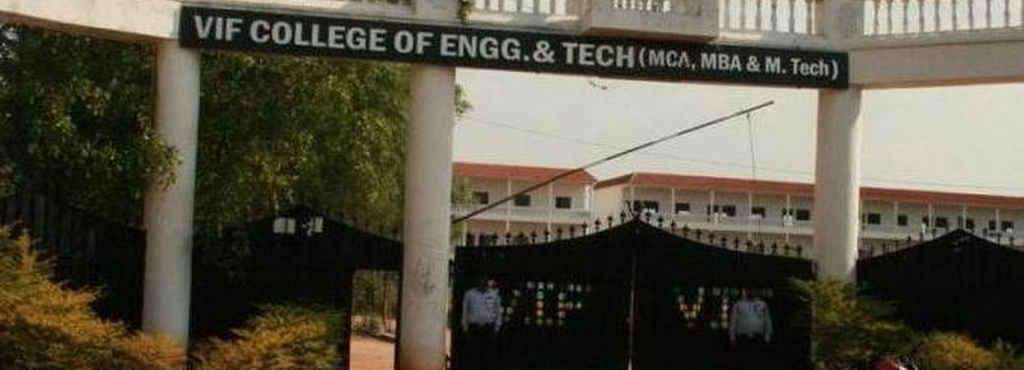
VIF College of Engineering & Technology
About
OfficialVIF College of Engineering & Technology is a other institution in Rangareddi, established in 2001. VIF College of Engineering & Technology, located in Rangareddi on the outskirts of Hyderabad, is a private engineering institution established in 2006 with a mission to provide quality technical education to students from diverse backgrounds. Situated approximately 35 km from Hyderabad's city center, the college operates as a co-educational institution offering undergraduate and postgraduate programs in various engineering disciplines. The institution is affiliated with Jawaharlal Nehru Technological University (JNTU) Hyderabad and is approved by the All India Council for Technical Education (AICTE). VIF College has evolved from a nascent engineering college into a multi-campus institution with satellite centers in different parts of Andhra Pradesh. The founding vision emphasized accessibility to engineering education for middle-class families while maintaining reasonable academic standards. Over its ~18 years of operation, the college has transitioned from purely traditional classroom delivery to incorporating modern pedagogical approaches, including flipped classroom models and experiential learning. The college operates three main undergraduate engineering programs (Civil, Mechanical, and Electronics & Communication Engineering) and several postgraduate programs including M.Tech in various specializations. Intake capacity for UG programs ranges from 120-180 students per branch annually, while PG programs accept 30-50 students. The college maintains a student-faculty ratio of approximately 17:1, which allows for reasonable accessibility during office hours, though formal mentoring systems are underdeveloped. Academic delivery follows a semester system with continuous internal assessment comprising 30-40% of total marks. The curriculum balances theory and practical work through laboratory components in core courses. The college has partnered with software companies including HCL Technologies, Infosys, and TCS for skill development initiatives, though these partnerships are largely transactional for campus recruitment rather than deep academic integration. Placement performance has shown gradual improvement, with 2023-24 data indicating ~78% placement rates for engineering UG programs. Most placements are in IT services (approximately 65% of placed students), with median salaries ranging from 4.2-5.8 LPA depending on branch. Core engineering placements remain weak, with manufacturing and infrastructure sectors recruiting fewer than 8% of graduates. The highest salary recorded was approximately 12 LPA for a select few Computer Science students, but this represents less than 1% of the batch. The campus infrastructure is functional but shows signs of aging. The main academic building houses 40 classrooms with basic audio-visual facilities in approximately 60% of rooms. Laboratories are available for electronics, mechanical, civil, and computer science disciplines, though equipment is often 4-6 years old and does not always reflect current industry standards. The library houses approximately 28,000 print volumes and provides access to digital databases including IEEE Xplore and Springer, though internet bandwidth during peak hours (2-5 PM) often throttles access. Research activity at VIF is limited. There is no dedicated research funding mechanism or PhD program. Faculty publications are sparse, with approximately 3-5 papers per faculty member annually across national and international conferences. The college lacks specialized research centers, though some faculty conduct consultancy projects with local manufacturing units. The focus remains primarily on undergraduate teaching rather than research advancement. Campus life is modest. The college operates four hostels (two for men, two for women) with a total capacity of approximately 800 students, though occupancy varies seasonally. Hostel rooms are shared (3-4 students per room) with basic furnishing. Mess food quality is average, with menus repeating weekly. The campus has a modest gymnasium, basketball court, and tennis court. Cultural and technical clubs exist but operate with minimal institutional support or funding. Annual events include a technical symposium (March), cultural fest (September), and sports day (February), though these are often poorly attended or organized due to low student enthusiasm. The college's location in Rangareddi presents both advantages and disadvantages. Proximity to Hyderabad's growing IT corridor provides internship and placement opportunities. However, the suburban location means limited access to entertainment, dining, and shopping options for students. Public transport connectivity to the city center is adequate but not seamless, requiring 45-60 minutes of travel time via city buses or auto-rickshaws. The nearest airport (Rajiv Gandhi International) is 50 km away, making frequent travel home logistically challenging for out-of-state students. Admissions primarily occur through JEE Main score-based counseling under OJEE (Odisha Joint Entrance Examination) in some years and direct engineering college merit lists in others. Acceptance rates are relatively high (approximately 35-45%) compared to top-tier engineering colleges, reflecting moderate academic competitiveness. The college admits students with JEE Main percentiles as low as 40th percentile for general category in the current admission cycle, indicating accessibility but also raising questions about peer quality and classroom dynamics. Student demographics are predominantly local (70% from Andhra Pradesh and Telangana), with 20% from Odisha and 10% from other states. Gender distribution is approximately 70% male and 30% female across the institution. The college attracts students from middle and lower-middle class backgrounds, as fees are substantially lower than top private engineering colleges while remaining higher than NIT or centrally-funded institutions. Who should apply: VIF College is suitable for students seeking affordable private engineering education with reasonable placement prospects in IT services, particularly those targeting service-based companies rather than core engineering roles. It is appropriate for students with moderate JEE scores (percentile 40-70) who value accessibility and location near a major IT hub. The college is less suitable for students with research aspirations, those seeking core engineering careers in manufacturing or infrastructure, or students requiring comprehensive student support systems. It appeals to practical, career-focused students willing to navigate modest campus infrastructure in exchange for cost-effectiveness and eventual IT sector employment. The institution represents a pragmatic middle ground for students unable to secure admission to NITs or top private universities but seeking better career prospects than tier-3 engineering colleges in smaller towns.