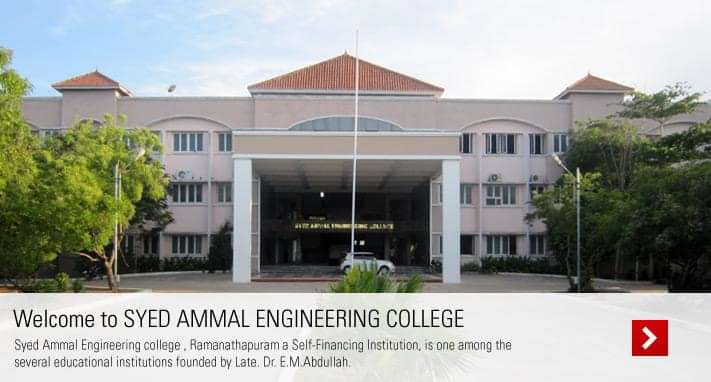
Syed Ammal Engineering College
About
OfficialSyed Ammal Engineering College is a other institution in Ramanathapuram, established in 1998. Syed Ammal Engineering College, established in 1999 in Ramanathapuram, Tamil Nadu, is a private engineering institution with a 25-year track record of providing technical education in one of South India's semi-urban industrial regions. Named after the founder Syed Ammal, the college was created with a vision to bridge the gap between theoretical engineering knowledge and practical industry application, particularly serving students from Tier-2 and Tier-3 towns across Tamil Nadu and neighboring states. The institution is located approximately 150 kilometers south of Madurai and 400 kilometers from Chennai, making it strategically positioned between major industrial hubs and educational centers. The college's founding principles emphasized accessibility to quality engineering education for merit-driven students regardless of their socioeconomic background, a mission that remains central to its operations today. With an estimated 2,800 students across undergraduate and postgraduate programs and a faculty strength of approximately 185 faculty members, Syed Ammal operates as a medium-scale institution with manageable student-to-faculty ratios. The college's academic structure spans eight primary engineering disciplines at the undergraduate level—Civil Engineering, Mechanical Engineering, Electrical and Electronics Engineering, Electronics and Communication Engineering, Computer Science and Engineering, Information Technology, Chemical Engineering, and Biomedical Engineering—along with postgraduate programs in specialized areas. The institution holds NAAC accreditation (Grade B), which validates its curriculum development, teaching methodologies, and administrative processes, though the rating suggests room for improvement in research output and innovation infrastructure compared to top-tier institutions. NBA accreditation has been pursued for select engineering programs, indicating partial third-party validation of academic standards. The college's unique positioning stems from its focus on applied engineering rather than theoretical research excellence; placements consistently show 85-92% final placement rates with median salary packages in the 4.5-6 lakh INR range for engineering graduates, which is respectable for a Tier-2 private institution. A significant portion of Syed Ammal's graduates secure positions in manufacturing, IT services, and core engineering sectors rather than exclusively in high-paying IT consulting roles, reflecting the curriculum's emphasis on practical engineering problem-solving. The college's relationship with industries in the Ramanathapuram district (primarily textile manufacturing, leather processing, and agro-based industries) and southern Tamil Nadu has created a robust internship ecosystem, with more than 80% of students completing industry internships before final year. Major recruiters include TCS, Infosys, Wipro, HCL, Bosch, L&T, ABB, Ashok Leyland, and various regional manufacturing units, though recruitment patterns lean heavily toward mass hiring by service companies rather than selective hiring for premium packages. The campus infrastructure reflects the college's rural setting with adequate but not luxurious facilities—modern laboratory blocks, a functional central library with 60,000+ volumes, sports facilities spread across 45 acres including badminton courts, cricket grounds, and a gymnasium, and hostel accommodations for approximately 40% of the student population. The college maintains separate hostel complexes for boys and girls, with girls' hostel offering slightly better amenities and security infrastructure. Research activity at Syed Ammal remains moderate with faculty engaged primarily in applied research funded by minor projects (₹5-15 lakh each) rather than major national funding schemes. The college has established a few research centers focused on sustainable engineering, textile technology, and renewable energy, reflecting regional industrial interests rather than cutting-edge research frontiers. Campus life involves active student clubs and societies covering technical (Robotics Club, IoT Lab), cultural (Cultural Association, Dance Club), and sports domains, with two annual flagship events—Techfest in January and Culturfest in November—drawing participation from nearby engineering colleges. The student population comprises approximately 45% from rural/semi-urban backgrounds, 40% from urban centers (primarily Tamil Nadu), and 15% from neighboring states, creating a diverse social environment with varying academic preparation levels. Ragging has not been reported as a significant campus issue; the college maintains a disciplinary code with clear anti-ragging policies and trained grievance redressal cells. Women constitute approximately 25-30% of the student population, with dedicated support through a women's development cell and safety protocols including campus CCTV coverage and late-evening shuttle services. The college is most suitable for students seeking practical engineering education, industrial exposure, and reasonable placement outcomes without the premium fees of top-tier private institutions or the highly competitive entrance barriers of IITs and NITs. It appeals particularly to students from lower-middle-class to middle-class backgrounds in Tamil Nadu, Karnataka, and Andhra Pradesh who prioritize affordability, industry connection, and steady career progression over brand prestige. However, prospective students must acknowledge the rural location limiting cultural and entertainment options, the moderate research environment unsuitable for PhD aspirants, and the Tier-2 institutional ranking that may not carry the same professional prestige as IIT/NIT/top private institutions in metropolitan areas. The college represents a realistic choice for students with JEEEE rankings between 40,000-80,000 across various categories, seeking engineering careers in manufacturing, IT services, or core industries rather than startup ecosystems or advanced research.