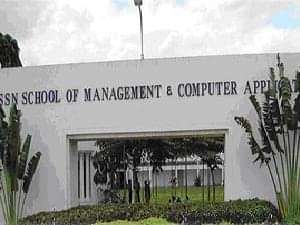
SSN School of Management
About
OfficialSSN School of Management is a other institution in Chennai, established in 2000. SSN School of Management (SSN SOM) is a post-graduate management institution established in 2008 as part of Sri Sivasubramaniya Nadar College of Engineering (SSNCOE), one of South India's most respected private engineering institutions. Located in the suburban Karapakkam area on Chennai's East Coast Road, the institution has grown into a significant player in business education with a focus on experiential learning and industry collaboration. The school operates under the umbrella of the Sri Sivasubramaniya Nadar Educational Trust, which has a legacy spanning over four decades in educational excellence. SSN SOM is accredited by NAAC with 'A' grade and has carved a niche for itself among tier-1 management colleges in South India, competing closely with established institutions like XLRI, ISB, and IIMA's satellite programs, though not at their scale. The institution offers MBA programs (2-year full-time and executive variants) with diverse specializations including Finance, Marketing, Operations, Human Resources, Supply Chain Management, and Analytics. The curriculum is designed with heavy industry partnership, with faculty actively engaged in consulting projects for companies like Infosys, Cognizant, and TCS. The school maintains a strong emphasis on developing domain expertise through specialized electives, case studies, and industry immersion programs. Placements consistently achieve 95-98% success rates with median salaries ranging from 12-18 LPA for core MBA graduates, and significantly higher packages (25-45 LPA) for specialized analytics and finance tracks. Top recruiters include Goldman Sachs, JP Morgan, BCG, McKinsey, Deloitte, Amazon, Google, Microsoft, HCL, Wipro, and various banking institutions. The institution has produced over 1,800 alumni working in senior roles across Fortune 500 companies globally. What distinguishes SSN SOM from larger metro-based B-schools is its location advantage (proximity to both IT companies in DLF IT Park and financial services in Bangalore-bound corridor), its integration with a strong engineering institution enabling tech specialization options, and its focus on working professionals through executive MBA and part-time programs. However, prospective students should note several considerations: the institution lacks international accreditations like AACSB or EQUIS (common among top-tier B-schools), the student cohort is significantly smaller than premier institutions (limiting large alumni networks), Chennai's business ecosystem, while growing, remains subordinate to Mumbai and Bangalore, recruitment is concentrated in technology and finance sectors with limited diversity, the campus setting is suburban requiring commute to city centers for internships, and competition with established Chennai institutions like ISB Hyderabad's Chennai programs and IIMA's distance learning arms. The student community is typically diverse, with 65-70% being Indian nationals and 30-35% international students from Southeast Asia, Middle East, and Africa. The institution attracts career-switchers, working professionals, and recent engineering graduates seeking MBA credentials. Campus life centers around management clubs (Entrepreneurship Club, Analytics Club, CSR Club), annual fests like 'Conclave' (business summit), 'Symposium' (technical), and 'Spectrum' (cultural), alongside sports and wellness initiatives. The institution prides itself on limited class sizes (batches of 40-50 students per specialization) enabling personalized mentoring, though this also restricts networking scale. It is ideally suited for: (1) engineering professionals seeking business credentials to transition into management roles, (2) candidates prioritizing placement guarantee in tech and finance sectors, (3) working professionals needing flexible part-time/executive MBA options, (4) students comfortable with suburban campus settings if offered strong academic and placement outcomes, and (5) those seeking specialized analytics or supply chain management training with practical industry projects. It is less suitable for candidates expecting: metropolitan campus experiences comparable to Delhi/Mumbai B-schools, large international partner university collaborations, diverse recruitment across healthcare, FMCG, pharma, and creative sectors, or students seeking prominent brand recognition in global MBA rankings.