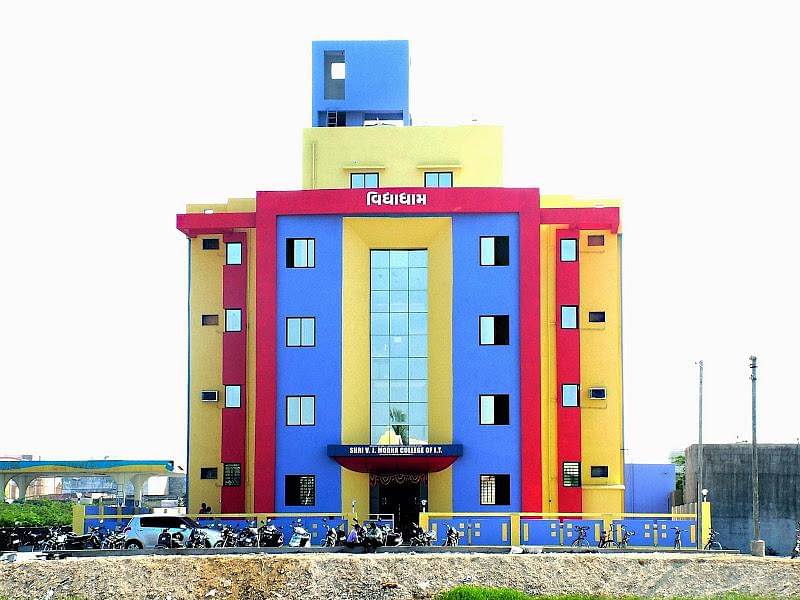
Shri V. J. Modha College
About
OfficialShri V. J. Modha College is a other institution in Porbandar, established in 2007. Shri V. J. Modha College, established in 1962 in Porbandar, Gujarat, is a premier general degree college serving the coastal region of Saurashtra. Named after the philanthropist Shri V. J. Modha, the institution has grown into a significant educational hub, offering undergraduate and postgraduate programs across arts, sciences, and commerce disciplines. The college operates under the affiliation of Saurashtra University and is recognized by the UGC under Section 2(f) and 12(B). The college's founding in the early 1960s coincided with India's push for democratization of higher education beyond metropolitan centers. Starting with a modest intake in humanities and sciences, it has expanded substantially over six decades, establishing itself as a bridge institution connecting talented students from smaller towns and villages to quality higher education. The college's strategic location in Porbandar—a coastal city with historical significance as the birthplace of Mahatma Gandhi—has attracted students seeking education in a balanced environment away from metro chaos but with modern facilities. Academic programs span three main undergraduate disciplines: Bachelor of Arts (BA), Bachelor of Science (BSc), and Bachelor of Commerce (BCom). Science streams include Physics, Chemistry, Mathematics, Biology, and Zoology as specializations. The Arts faculty offers humanities tracks including History, Political Science, Economics, English, and Gujarati literature. The Commerce stream prepares students for finance, accounting, and business management careers. Postgraduate programs include MA in History, Political Science, and Economics; MSc in Chemistry and Zoology; and MCom. The college also offers diploma and certificate courses in emerging fields like digital marketing and e-commerce. Research strengths center on regional history studies, environmental sciences particularly focusing on coastal ecology, and applied chemistry research. The college has established a research center for Saurashtra regional studies that documents local historical archives and cultural heritage. Faculty members actively engage in UGC-funded minor and major research projects, though the research output remains modest compared to metropolitan institutions. Several research scholars from neighboring universities utilize the college's laboratory facilities for thesis work. Campus infrastructure has modernized significantly in the last decade. The institution operates a Central Library housing 42,000 volumes, departmental laboratories with recent equipment, computer labs with 200+ systems offering access to online journals and databases, and a well-maintained sports complex. WiFi coverage extends across 90% of the campus. The college has invested in smart classrooms in select departments, though traditional lecture halls still predominate. Internet connectivity averages 15 Mbps, sufficient for academic work but occasionally strained during peak hours. Placement performance reflects the college's positioning as a secondary/tertiary tier institution. Average placement percentage hovers around 65-70% across commerce and arts streams, with science graduates showing slightly higher placement rates (75-78%) due to laboratory skills valued in pharmaceutical and chemical industries. Median salaries for placed graduates range from 300,000-420,000 INR annually, with top 10% achieving 600,000+ INR. Primary recruiters include retail chains, small-to-medium manufacturing units, educational institutions, banking sector (clerical/probationary officer roles), and IT services companies offering support/junior developer roles. Notably, the college does not attract top-tier tech companies or investment banking firms—students aspiring for those sectors typically transition elsewhere after undergraduate study. Campus life reflects the college's suburban setting and moderate student population. Hostels accommodate approximately 480 students (roughly 20% of total enrollment), with separate facilities for men (320 beds) and women (160 beds). Hostel quality is basic-to-average, with 3-4 students per room, shared bathrooms, and limited air conditioning. Mess facilities serve vegetarian and non-vegetarian options, with quality described by residents as adequate but monotonous, typical of institutional feeding. Monthly hostel cost ranges from 8,000-12,000 INR including mess charges. Student clubs include technical societies (Programming Club, Science Club), cultural organizations (Dance, Music, Theater), and sports bodies managing inter-college competitions. Two major annual festivals drive campus engagement: Varsha Utsav (March, cultural festival) and Science Fair (November). Sports infrastructure includes a cricket ground, basketball and badminton courts, table tennis facilities, and a gymnasium. Athletic participation is moderate—the college has performed respectably in district-level competitions but does not dominate Gujarat-level tournaments. Academic experience is characterized by traditional teaching methodologies, with faculty predominantly relying on lectures, tutorials, and prescribed textbooks. Modern pedagogies like case studies, project-based learning, and online classrooms are slowly being introduced but remain inconsistent across departments. Faculty-student interaction is generally approachable; student-faculty ratios average 1:16 in humanities and 1:12 in sciences, allowing reasonable access. However, several faculty members hold additional responsibilities as college administrators, sometimes limiting availability. Student workload is moderate; assessment relies heavily on annual/semester examinations supplemented by internal continuous evaluation. The college emphasizes attendance discipline, with 75% mandatory attendance policy strictly enforced. Admissions are primarily merit-based through board examination scores (12th standard marks) for undergraduate entry. Postgraduate admissions consider graduation marks and entrance examination scores. The college follows Gujarat's reservation policy allocating seats for SC, ST, OBC, and EWS categories. No entrance examination is required for undergraduate admission, making access relatively straightforward for eligible students. Acceptance rates are high (estimated 40-50%) due to moderate competition for seats. Notable strengths include affordable fee structure (annual tuition 18,000-22,000 INR for undergraduate), accessibility from surrounding towns via regular bus services, faculty expertise in regional subjects, and a safe, community-oriented campus environment. The college serves as an important feeder institution for government jobs, as several graduates successfully crack civil services and state-level examinations after additional preparation. Key limitations merit honest acknowledgment: The college's research output remains limited with few publications in high-impact journals; infrastructure, while adequate, lacks cutting-edge laboratories common in metro colleges; IT infrastructure suffers occasional bandwidth constraints; and industry linkages are primarily regional rather than national/global. Placement in premium sectors (top tech, consulting, finance) is rare. Academic innovation lags national leaders; online learning infrastructure, though functional post-COVID, remains basic. Few international collaborations or faculty exchange programs exist. The city's limited nightlife and entertainment options may feel restrictive to students accustomed to metro culture. Summer internship opportunities require significant student initiative, as the placement cell, though competent, has limited corporate networks beyond Gujarat. Who should apply: Shri V. J. Modha College suits students prioritizing affordable, accessible education in a secure environment over prestigious branding. It appeals to students from lower-income families seeking quality general education, those aiming for competitive government examinations, and students preferring a smaller-town, slower-paced academic setting. The college works well for students pursuing teaching careers, wanting to focus on core academics without distraction, or planning further postgraduate study at metros. It is less ideal for students pursuing ultra-competitive placements, seeking research-focused education, or requiring advanced technical infrastructure for specialized studies. Students aspiring for top-tier professional careers (IIM, NLU, premium tech jobs) should view this as a stepping stone requiring additional preparation elsewhere post-graduation.