Shimoga Institute of Medical Sciences
About
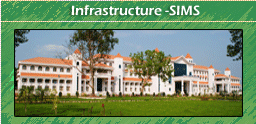
OfficialShimoga Institute of Medical Sciences is a other institution in Shimoga, established in 2005. Shimoga Institute of Medical Sciences (SIMS) is a government-aided medical college located in Shimoga, Karnataka, established in 2010 as part of India's initiative to increase medical education capacity in underserved regions. It operates under the purview of Rajiv Gandhi University of Health Sciences (RGUHS) and is recognized by the Medical Council of India (now National Medical Commission). The institute has evolved from a regional medical school to a comprehensive teaching hospital with significant research contributions in tropical diseases, rural health, and public health. SIMS was established to address the acute shortage of medical professionals in the Western Ghats region and has maintained a strong commitment to community-focused medicine. The institution offers undergraduate (MBBS) and postgraduate (MD/MS) programs across 13 major specialties, with emphasis on creating healthcare professionals capable of addressing rural healthcare challenges. The campus is strategically located on the Jnana Sahyadri campus, sharing infrastructure with other health science institutions, providing exposure to integrated learning across nursing, pharmacy, and other allied health sciences. The college maintains 600 MBBS intake capacity distributed across multiple batches and runs 13 MD/MS postgraduate programs. Research at SIMS focuses on communicable diseases prevalent in the region, nutritional disorders, maternal-child health outcomes, and implementation of public health interventions. The institution has collaborations with international medical schools including partnerships with universities in the UK and Australia for student exchanges and research collaborations. Faculty members are actively involved in community health programs across 250+ villages in the region, making SIMS one of the few medical colleges in India with deep rural health engagement. The college has produced approximately 800+ MBBS graduates since inception, with significant representation in government positions, academic institutions, and private healthcare. Placement outcomes show 92-95% employment within 12 months of completion, though salary structures lag behind metropolitan medical colleges. The institute is known for its affordability (annual fees under ₹2,00,000 for government seats), accessibility via merit-based admissions through NEET, and commitment to medical education rooted in social responsibility. Campus infrastructure includes a 500-bed teaching hospital with modern diagnostic facilities, 24 operation theaters, well-equipped digital library, research laboratories, and hostel accommodation for 400+ students. The college operates with a lean budget compared to private medical colleges but compensates through rigorous clinical training and high patient volume exposure. Notable strengths include strong community medicine orientation, low faculty-to-student ratio (1:6), commitment to producing doctors for underserved regions, and a culturally balanced student community from across India. Weaknesses include limited advanced research funding compared to AIIMS, smaller library with limited rare journals, older infrastructure in some departments, limited international visibility, and lower median salaries compared to top-tier medical colleges. The institution is ideal for aspirants seeking affordable, quality medical education with rural health focus, those interested in public health, epidemiology, and community medicine, students from economically weaker backgrounds seeking subsidized tuition, and those willing to work in government healthcare systems. SIMS produces clinicians rather than researchers; hence it is less suitable for those pursuing full-time research careers or seeking top-tier private practice opportunities immediately after graduation.