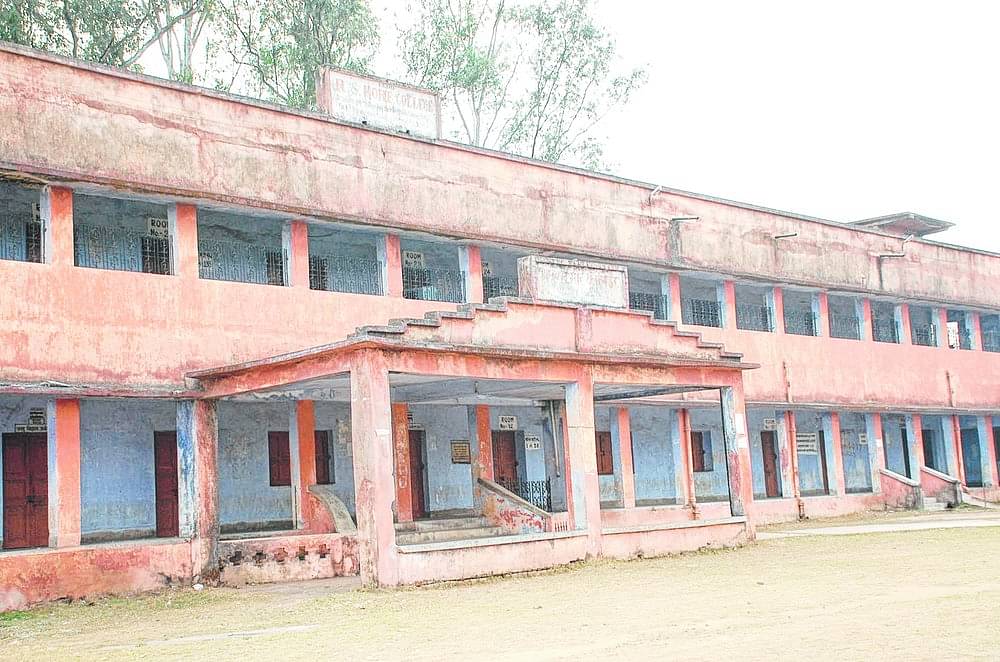
R.S. More College
About
OfficialR.S. More College is a other institution in Dhanbad, established in 1959. R.S. More College, established in 1948, is one of Dhanbad's oldest and most respected educational institutions, playing a pivotal role in higher education across Eastern India. Named after the philanthropist R.S. More, the college has evolved from a small arts college to a multi-disciplinary institution offering undergraduate and postgraduate programs across Sciences, Arts, Commerce, and Engineering disciplines. The college is located in the heart of Dhanbad, a city historically dominated by coal mining but rapidly diversifying into education and technology sectors. Founded post-independence, R.S. More College has maintained strong academic traditions while adapting to modern pedagogical approaches. The institution serves approximately 2,800 students across various programs with a faculty strength of around 180 dedicated educators. The college is affiliated with Vinoba Bhave University and follows the Choice Based Credit System (CBCS), aligning with national education standards. Academically, the college is known for strong fundamentals in humanities, social sciences, and foundational sciences. The Science departments, particularly Physics, Chemistry, and Biology, have established excellent laboratories and teaching facilities. The college has progressively expanded into professional education, introducing engineering programs to cater to the growing demand for technical professionals. Its Arts and Commerce streams continue to produce administrators, educators, journalists, and professionals across various sectors. Research activities are moderate but growing, with faculty members engaged in departmental research projects funded through government agencies. The college has established research centers in environmental science and social studies. Faculty development programs are conducted regularly, and several faculty members hold PhD qualifications from reputed universities. The college maintains a moderate emphasis on research publications, with faculty contributing to national and regional journals. Placement statistics, while decent, are significantly lower than premier institutions. Around 35-45% of graduates secure placements through campus recruitment, with median salaries ranging from 2.5-3.5 lakh annually for science and commerce graduates. Engineering graduates fare better with placement rates around 60-65% and median salaries of 4-5 lakh. However, many students pursue further studies in postgraduate programs or government exams. The college has partnerships with various IT companies, financial institutions, and manufacturing firms for internships and placements. Notable alumni include civil servants, academics, journalists, and business professionals who have made contributions in their respective fields. Dr. Rajesh Kumar Singh, a renowned environmental scientist, completed his undergraduate studies here before moving to advanced research. Anil Sharma, an IAS officer from the 2010 batch, serves in prominent administrative positions. Several alumni have established successful entrepreneurial ventures in education technology and consulting sectors. The campus culture emphasizes academic rigor combined with social responsibility. The college has been actively involved in community development initiatives through NSS activities, focusing on environmental conservation, rural education, and health awareness. The college conducts regular seminars, workshops, and guest lectures by industry experts and accomplished alumni. Annual cultural festivals, annual sports meets, and departmental events are integral to campus life. The library houses over 35,000 books with good coverage of standard texts and reference materials, though specialized research journals are limited. Computer labs are functional though not state-of-the-art, serving the requirements of science and commerce students adequately. Internet connectivity across campus is improving, with WiFi coverage in academic buildings and administrative areas. The college recognizes merit and maintains scholarship programs for economically disadvantaged students. The institution charges reasonable fees compared to private colleges, making quality education accessible to middle-class families. The college has a transparent admission process and maintains good communication with prospective students. Who should apply: Students seeking traditional, values-based education with moderate infrastructure. Those from lower-middle-class backgrounds seeking affordable quality education. Students interested in humanities and social sciences with good growth potential. First-generation learners seeking supportive academic environment. Those aspiring for government exams and civil services. Candidates willing to develop themselves through self-study and discipline rather than relying entirely on institutional resources. Students valuing ethical and community-oriented education.