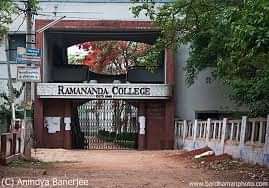
Ramananda College
About
OfficialRamananda College is a public institution in Bankura, established in 1945. Ramananda College, established in 1820 as one of West Bengal's oldest educational institutions, holds significant historical and academic importance in the region. Located in Bankura, a tier-3 city in West Bengal, the college has evolved from its colonial-era origins into a modern multi-disciplinary institution offering undergraduate and postgraduate programs across sciences, humanities, commerce, and applied fields. The college is named after the 15th-century Bengali saint-poet Ramananda and carries a legacy of cultural and intellectual contribution to Eastern India. With over two centuries of academic tradition, Ramananda College serves approximately 3,200 students across various undergraduate and postgraduate programs, supported by a faculty of 140 qualified educators. The institution has successfully maintained its position as a respectable tier-2 college in West Bengal, competing effectively with other regional institutions despite not being part of the NIT or IIT network. The campus spans 15 acres in a suburban setting, providing a balanced environment between academic rigor and community engagement. Academically, Ramananda College maintains strengths in traditional sciences (Physics, Chemistry, Biology), humanities (English, History, Political Science), and commerce disciplines. The college has recently expanded into professional programs including Bachelor of Computer Applications (BCA), Bachelor of Business Administration (BBA), and diploma programs in vocational trades. Research at Ramananda College is modest but growing, with faculty actively engaged in regional studies, environmental science, and applied chemistry research. Several departments have established research facilities supported by UGC grants, though research output remains below that of central universities. The college is affiliated with the University of Burdwan for most undergraduate and postgraduate programs, which provides curriculum oversight but also limitations in academic autonomy. Campus life at Ramananda College reflects a traditional Indian college experience with active student unions, annual cultural fests, and active student clubs. The college hosts 'Ramananda Utsav,' an annual cultural festival spanning 3-4 days, featuring music, drama, sports, and academic competitions. Sports facilities include a cricket ground, volleyball court, badminton courts, and gymnasium, though these are somewhat dated. Hostel facilities exist for both men and women students, with separate accommodations providing basic amenities. The college library houses approximately 45,000 volumes including historical manuscripts and is a significant resource for regional academic research. Placement and career outcomes have been a developing area for Ramananda College. While historically the college focused on academic development and research for advanced degree pursuits, recent years have seen increased emphasis on industry placements. Placement percentages for undergraduate programs range from 55-70% depending on the stream, with average salaries in the 3.5-4.5 LPA range for engineering and commerce graduates. Science stream graduates primarily pursue further studies or research positions. Major recruiters include regional IT companies, educational institutions, government organizations, and some national-level companies for specialized roles. The college's location in a smaller city limits exposure to top-tier multinational corporations, though virtual recruitment drives have expanded opportunities in recent years. Notable alumni include academics, government officials, and professionals in education and public administration sectors. Alumni networks, while established, are less formalized compared to metropolitan institutions, though efforts are being made to strengthen alumni engagement for mentoring and recruitment. The college is particularly suitable for students seeking a traditional academic environment with emphasis on conceptual learning, research orientation, and cultural development. It appeals to students from West Bengal and neighboring regions who prioritize a supportive community atmosphere over aggressive placement dynamics. The college is honest about its limitations: it is not a placement powerhouse, the city offers limited corporate opportunities, and infrastructure modernization is ongoing. However, students valuing solid academics, faculty mentorship, cultural exposure, and a close-knit community find value here. The teaching methodology emphasizes classroom learning, seminars, and projects with increasing digital integration. Ramananda College functions as a regional academic hub maintaining standards while remaining accessible to middle-class students, making it a pragmatic choice for those seeking quality education in a smaller city setting without the competitive intensity or high costs of metropolitan institutions.