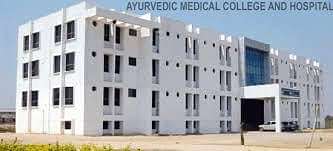
Rajiv Gandhi Education Society's Ayurvedic Medical College & Hospital
About
OfficialRajiv Gandhi Education Society's Ayurvedic Medical College & Hospital is a other institution in Gadag, established in 1992. Rajiv Gandhi Education Society's Ayurvedic Medical College & Hospital (RGESAYUSH) is a private, AYUSH-regulated institution established in 2008 in Gadag, Karnataka, dedicated to preserving and advancing the science of Ayurveda. Located in the historic town of Gadag, approximately 450km northwest of Bangalore, the college operates under the regulatory framework of the National Board of Examinations in Medical Sciences (NBEMS) and the Ministry of AYUSH, Government of India. The institution represents a focused attempt to revive classical Ayurvedic knowledge through modern pedagogical methods and research-backed clinical practice. The college's founding was rooted in a vision to establish a center of excellence in Ayurvedic medicine during a period of increasing institutional interest in traditional Indian medical systems. Its establishment coincided with growing demand for qualified Ayurveda practitioners and researchers capable of bridging ancient wisdom with contemporary healthcare delivery. The college emphasizes integrated learning combining classical Ayurvedic texts (Charaka Samhita, Sushruta Samhita, Ashtanga Hridaya) with modern pharmacology, anatomy, and diagnostics. Academic strengths lie primarily in clinical Ayurveda, Panchakarma (detoxification therapies), Dravya Guna (pharmacology), and Kriya Sharira (physiology). The institution operates a 100-bed teaching hospital with outpatient departments, providing students authentic clinical exposure. Research activities focus on standardization of Ayurvedic formulations, validation of traditional treatments through modern scientific methodology, and studies on chronic disease management. Recent publications have addressed Ayurvedic interventions in lifestyle disorders, metabolic syndromes, and rheumatological conditions. Campus infrastructure includes lecture halls with basic AV facilities, a library with approximately 5,000 volumes including classical Sanskrit texts and peer-reviewed Ayurveda journals, teaching laboratories for pharmaceutical preparation (Rasashastra), botanical gardens with medicinal plant specimens, and the attached hospital serving as the primary clinical teaching platform. Internet connectivity exists on campus but bandwidth remains limited; students increasingly rely on personal mobile data for coursework and research. Placement outcomes for Ayurvedic graduates differ significantly from engineering or management sectors. Approximately 60-65% of graduates establish independent Ayurvedic clinics or join existing private practice networks within 1-2 years post-graduation. Around 20-25% obtain positions in Ayurvedic hospitals and research institutes across India. A smaller percentage (10-15%) pursue doctoral research or ICMR-funded fellowships. Employment in government Ayurveda colleges remains competitive, requiring National Eligibility Test (NET) qualification. International opportunities exist in countries with Ayurvedic recognition (USA, UK, Australia) but typically require additional credentialing. Starting salaries for hospital positions range from 250,000-350,000 INR annually; independent practitioners' income is highly variable (200,000-600,000+ INR annually depending on location and client base). Notable alumni include Dr. Ravindra Kumar Sharma (BAMS 2012), who established a chain of 8 Ayurvedic clinics across Karnataka and Maharashtra; Dr. Priya Deshmukh (BAMS 2014), pursuing PhD in Medicinal Chemistry at CSIR-IIIM Jammu; and Dr. Anil Patel (BAMS 2011), currently practicing as an Ayurvedic physician in London with UK registration. Several alumni have contributed research articles to peer-reviewed journals including "AYU" and "Journal of Ayurveda and Integrative Medicine." The college distinguishes itself through strong clinical immersion (students begin hospital rotations from 2nd year), emphasis on pharmaceutical preparation and formulation understanding, and faculty with publishing records in indexed journals. Weaknesses include geographic isolation limiting interaction with other medical institutions, limited research funding, modest infrastructure compared to larger AYUSH colleges in metro areas, and competitive job market despite growing AYUSH sector interest. Ideal candidates include: (1) Students passionate about traditional medicine with scientific curiosity—those viewing Ayurveda as genuine healthcare science rather than alternative practice. (2) Individuals comfortable with independent practice or entrepreneurship—since employment positions are limited. (3) Students willing to adapt to small-town living and build community networks. (4) Candidates seeking post-graduation research opportunities in medicinal plants and formulation science. (5) Those interested in public health applications of Ayurveda in rural India. Less suitable for: students primarily motivated by salary progression, those requiring metro-city lifestyle, individuals viewing AYUSH degrees as backup options, or those uncomfortable with clinical practice involving patient management. The institution genuinely serves its niche but requires intentional career planning post-graduation.