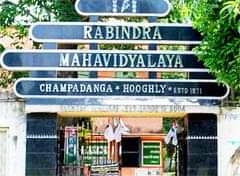
Rabindra Mahavidyalaya
About
OfficialRabindra Mahavidyalaya is a other institution in Hooghly, established in 1971. Rabindra Mahavidyalaya, established in 1947 in Hooghly district of West Bengal, is a premier general degree college with deep roots in India's post-independence educational movement. Named after Rabindranath Tagore, the institution emerged as a beacon of accessible higher education in a region historically underserved by quality colleges. Over 75 years, it has evolved from a modest institution serving local communities to a recognized center of academic excellence drawing students from across Bengal and neighboring states. The college operates under the affiliation of the University of Calcutta and is recognized by the UGC under Section 2(f) and 12(B). Its commitment to holistic education blends rigorous academics with character development, staying true to Tagore's philosophy of education as a transformative force. The institution has weathered various transitions—from pre-independence struggles through the Green Revolution era to today's digital transformation—while maintaining its core mission of providing quality education at affordable costs. Academically, Rabindra Mahavidyalaya offers undergraduate programs across Sciences, Commerce, and Humanities disciplines. The science stream includes Physics, Chemistry, and Mathematics (PCM), as well as Botany, Zoology, and Chemistry (BZC) combinations. Commerce students pursue traditional accounting and business studies curricula. The humanities faculty provides comprehensive programs in English, Bengali, History, Political Science, and Philosophy. Postgraduate programs in select disciplines like English Literature and History have recently been introduced, reflecting institutional growth. The college has gradually strengthened its research infrastructure. While research output remains modest compared to central universities, the institution has established basic laboratories for undergraduate experimentation and has faculty engaged in topic-specific research. Several departments have initiated departmental research projects funded by UGC Minor Research Schemes. The library houses approximately 45,000 volumes with a dedicated digital resource section, though students report that access to premium online journals remains limited. Placement outcomes have shown incremental improvement. For science graduates, roughly 35-40% secure employment in education sector positions, IT companies seeking graduate trainees, or administrative roles. Commerce graduates find better employment prospects with placement rates around 45-50%, primarily in banking, finance, and administrative sectors. However, competitive placements remain limited; most successful graduates either pursue higher education or enter public sector positions through civil service examinations. The campus culture emphasizes community engagement and cultural preservation. The college organizes regular seminars, lectures by visiting scholars, and cultural programs celebrating Indian heritage. Annual fests like Rabindra Jayanti celebrations and inter-college competitions foster intellectual and cultural exchange. The institution maintains active sports programs with facilities for cricket, football, badminton, and athletics, though investment in modern sports infrastructure remains constrained. Student life at Rabindra Mahavidyalaya reflects the character of a suburban college serving aspirational middle-class families. The majority of students are first-generation degree holders from nearby districts, bringing diverse perspectives and high motivation. The college's affordable fee structure—significantly lower than private institutions—makes it accessible to economically modest families. However, campus amenities reflect budget constraints: hostels are functional rather than luxurious, and digital connectivity, while improving, remains inconsistent. The faculty comprises dedicated educators, many with advanced degrees from reputable universities. However, faculty engagement in research remains limited due to heavy teaching loads and administrative responsibilities. Some senior faculty members have published in regional journals and conducted minor research projects. The institution values mentorship and approachability, with many students citing strong rapport with faculty as a distinctive feature. Notable strengths include institutional stability, cultural rootedness in Tagore's philosophy, affordability, and strong community connections. The college serves as a crucial stepping stone for talented students from economically disadvantaged backgrounds, enabling upward mobility. Alumni networks, while informal, remain active in various professional fields. Limitations are significant: research infrastructure cannot match central universities, placement opportunities in high-technology sectors are limited, campus facilities require modernization, and competitive exam performance trails top-tier institutions. The college operates under university affiliation constraints that limit curricular innovation. Library resources, while respectable, lack comprehensive digital access. Hostel facilities accommodate only a portion of out-station students. Rabindra Mahavidyalaya is ideally suited for merit-oriented students from West Bengal and neighboring regions seeking quality education at reasonable costs, particularly those planning to pursue competitive examinations for government positions or higher education. It works best for students who value cultural and intellectual development alongside academics. The institution attracts students committed to social responsibility and community engagement. Students seeking exclusively job-focused, technology-intensive education with modern amenities might find better options in specialized institutions or tier-1 private colleges.