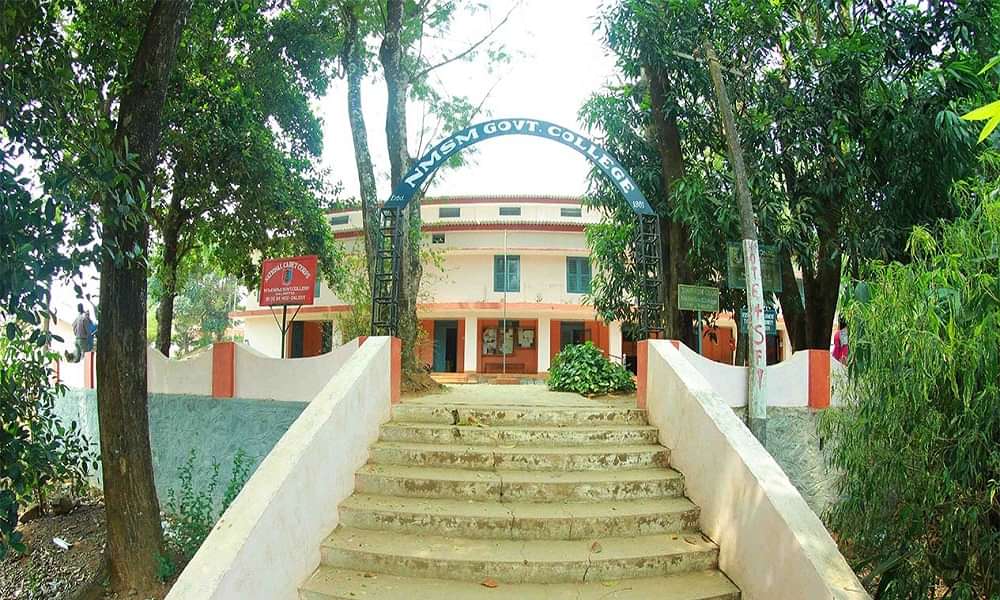
N.M.S.M. Government College
About
OfficialN.M.S.M. Government College is a public institution in Kalpetta, established in 1981. N.M.S.M. Government College, located in Kalpetta, Wayanad, Kerala, is a premier government-aided liberal arts institution established in 1962. The college has evolved from its founding mission to become a significant academic hub in the Wayanad district, serving students primarily from the surrounding northern Kerala regions and gradually attracting recognition across the state. Named after the historical Nair Service Society, the institution was established to provide accessible higher education to the rural and semi-urban population of Wayanad during the post-independence education expansion phase. The college operates under the oversight of the Government of Kerala and maintains affiliation with the University of Calicut (now Calicut University), which frames academic curricula and conducts final examinations. Over six decades, N.M.S.M. has positioned itself as a comprehensive undergraduate institution offering humanities, sciences, and commerce disciplines with a particular emphasis on providing quality education in a geographically isolated region where educational infrastructure is sparse. The academic structure is organized into three principal faculties: humanities (including languages, history, economics, political science, sociology), sciences (physics, chemistry, mathematics, and allied disciplines), and commerce (accounting, business studies, economics). The college offers 8 undergraduate honors programs spanning three years, with intake capacities ranging from 40 to 60 students per program depending on discipline. The curriculum follows the Choice Based Credit System (CBCS) implemented by Calicut University, allowing students some flexibility in course selection. Faculty research initiatives, while modest in scale compared to metropolitan institutions, focus on applied research in agriculture and environmental studies relevant to Wayanad's ecological context. The institution has established departmental research cells in biology, chemistry, and economics, though formal doctoral programs remain absent. Industry-academia partnerships are primarily localized, involving agricultural cooperatives, spice trading organizations, and small-scale manufacturing units based in Wayanad and adjacent districts. Placement outcomes, while not matching metropolitan college standards, have shown steady improvement in recent years. The 2023-24 placement cycle saw approximately 45-48% of graduating students securing employment, with median packages around 2.8-3.2 lakhs annually, primarily in education, banking, and government sectors. Top recruiting organizations include State Bank of India (clerical cadre), HDFC Bank (back-office roles), insurance PSUs like National Insurance Company, and educational institutions in Kerala and Karnataka. The placement cell operates with moderate sophistication—recruiters visit less frequently than in tier-1 institutions, and students must actively network with external organizations. Career guidance is limited to basic resume workshops and mock interviews. A significant proportion of graduates (30-35%) pursue further studies in postgraduate programs across Indian universities, particularly teacher training courses and MBA programs through distance education. The college has not produced breakthrough entrepreneurial ventures, though there is emerging interest among commerce students in starting small retail and service enterprises. Campus infrastructure reflects the challenges and advantages of its rural location. The main campus spans approximately 18 acres across a semi-forested terrain on the outskirts of Kalpetta town, providing a peaceful, distraction-reduced study environment but simultaneously creating connectivity and accessibility issues. Library facilities are adequate with approximately 35,000 volumes and limited digital resources access (currently improving). Laboratory facilities for sciences are functional but aging, with equipment last upgraded 5-7 years ago. Internet connectivity on campus operates at 10-15 Mbps through a government broadband connection, sufficient for general browsing but inadequate for heavy data access or online examination proctoring during peak hours. The college operates one women's hostel (approximately 120 beds) and one men's hostel (approximately 100 beds), both charging around 12,000-15,000 per month. Hostel rooms are basic but maintained adequately; mess food is primarily Kerala-style cuisine at approximately 4,000-4,500 monthly. Dining facilities are limited with one main canteen and a small cafeteria. Medical facilities consist of a basic health center with a full-time nurse and visiting physician, referrals to Kalpetta's private hospitals for serious cases. The campus lacks a formal sports complex, though outdoor spaces accommodate cricket, volleyball, and badminton. Gymnasium equipment is minimal and outdated. A swimming pool does not exist. Student life at N.M.S.M. reflects a tight-knit, community-oriented environment shaped by the college's rural location and relatively small population. Over 60% of enrolled students are local to Wayanad district, commuting daily from nearby villages. Residential students comprise approximately 35% and face genuine isolation if they lack family networks in the region—the nearest shopping district (Kalpetta) is 8 km away, and entertainment options are severely limited. The cultural atmosphere is conservative with strong Malayalam literary traditions; the annual college magazine and cultural fest ('Athroopam') are principal social events featuring classical art forms, drama, and music. Technical clubs and entrepreneurship initiatives are emerging but remain nascent. Political activism among students exists but is moderate compared to major university centers. The college maintains strict dress codes (no jeans for women on campus, though enforcement is inconsistent) and has experienced no documented ragging incidents in recent years due to proactive anti-ragging cell interventions. Gender balance has shifted—approximately 55% female enrollment currently, reflecting broader trends in Indian liberal arts education. Safety for women on campus is generally strong due to small population density and active administrative oversight. However, off-campus safety varies; Kalpetta town and surrounding villages have low crime rates but limited late-night mobility options for women. N.M.S.M. Government College is most suitable for students seeking quality liberal arts education in a serene, distraction-free setting prioritizing academic focus over extracurricular cosmopolitanism. It appeals strongly to students from Wayanad and surrounding districts requiring affordable, accessible higher education with minimal geographical disruption. The college suits introverted learners and those genuinely interested in humanities and social sciences rather than professional career acceleration. It does NOT suit students seeking extensive placements, research exposure, international collaborations, or urban campus vibrancy. Candidates should approach with realistic expectations: quality teaching in traditional domains, limited career services, sparse digital infrastructure, and a geographically isolated setting that demands self-sufficiency and minimal external social outlets. The institution's strength lies in providing dignified, affordable educational access to rural populations and fostering strong faculty-student mentorship relationships; its primary limitation is inadequate investment in modern infrastructure and professional placement ecosystem development.