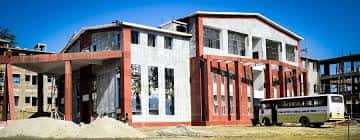
National Institute of Technology Arunachal Pradesh
About
OfficialNational Institute of Technology Arunachal Pradesh is a public institution in Papum Pare, established in 2010. National Institute of Technology Arunachal Pradesh (NIT Arunachal Pradesh) was established in 2010 as one of India's newer NIT institutions, bringing centrally-funded engineering education to India's northeastern frontier. Located in Papum Pare district, approximately 30 km from Itanagar, the capital of Arunachal Pradesh, the institute sits at a unique geographical and strategic location that positions it as a regional hub for technical education in the North-Eastern region. The founding was part of India's broader expansion of quality engineering education beyond metro and tier-1 cities, targeting underserved regions with high potential. The campus itself occupies 85 acres of relatively undeveloped land in a semi-rural setting, offering a peaceful but isolated environment. This location is simultaneously an advantage (minimal urban distractions, close-knit community feel, lower living costs) and a significant challenge (limited job opportunities nearby, reduced social infrastructure, dependence on campus facilities for most activities). The institute operates under the purview of the Ministry of Education (formerly MHRD) and follows the standard NIT curriculum framework while adapting to regional educational priorities. Academically, NIT Arunachal Pradesh offers undergraduate and postgraduate programs primarily in Engineering disciplines, with a current focus on core branches like Civil, Mechanical, Electrical, Electronics & Communication, and Computer Science Engineering. The institute has been developing its research infrastructure incrementally, though it remains significantly behind older NITs in terms of established research centers, funded projects, and published research output. The faculty strength of approximately 145 members is distributed across departments, with an increasing emphasis on doctoral qualifications and industry experience. The institute's academic environment is characterized by smaller class sizes compared to older NITs—average batch strength per branch is 60-80 students—allowing for better student-faculty interaction. However, the teaching quality varies significantly across departments, with some faculty members being highly engaged researchers while others remain primarily teaching-focused. The curriculum follows the standard NIT pattern with emphasis on core engineering fundamentals, practical experience through internships, and industry-relevant projects in the final year. Research at NITAP is still in a developmental phase. The institute has recently established a few research centers focusing on renewable energy, water resources management, and materials science—areas relevant to Arunachal Pradesh's development priorities. However, the research output measured by publications and patents remains modest compared to older NITs. Industry partnerships are gradually expanding, with companies like Assam Gas Cracker Complex, Northeast Power Company, and various Arunachal Pradesh state government departments showing interest in internship and collaborative programs. Placements have been a growing strength of the institute, particularly for Computer Science and Electronics graduates, with campus recruitment showing an upward trajectory since 2019. The 2023-24 placement data shows approximately 78-82% of graduating students receiving job offers, though this comes with important caveats: many placements are from IT services companies offering entry-level positions at 8-12 LPA; core engineering and manufacturing placements remain limited; and a significant portion of placed students eventually relocate to metros for career advancement. The placement infrastructure includes a dedicated placement cell with industry tie-ups, though the reach remains primarily to Indian companies, with minimal international placements. Student life at NITAP is heavily campus-centric due to the rural location. The institute hosts several annual festivals including Technovanza (technical fest in October), Apogee (cultural fest in March), and various departmental events. There are approximately 40+ student clubs covering technical, cultural, and sports interests. The hostel facilities accommodate around 85-90% of students, with separate blocks for boys and girls. Internet connectivity across campus is reasonably good (30-50 Mbps average), enabling online learning and research activities. The mess quality is described as average to below-average by many students, with limited food variety and occasional quality concerns. The institute has maintained a relatively clean record regarding ragging, with institutional measures and strict enforcement contributing to a safe campus environment. The safety for women students is reported as good, with dedicated women's hostel blocks, CCTV coverage in common areas, and regular awareness programs. However, the rural location and distance from major urban centers means limited exposure to diverse social experiences during the college years. Who should apply to NIT Arunachal Pradesh? The institute is ideal for students who prioritize quality education from a centrally-funded institution, can adapt to semi-urban/rural campus life, and are willing to invest in their technical foundation even if campus placements are not among the very top-tier. It suits students from Northeast India wanting to stay closer to home while pursuing NIT education, students seeking a less competitive, more collaborative learning environment than older NITs, and those interested in contributing to regional development through engineering. It is less suitable for students primarily focused on urban campus life, high-paying IT placements immediately after graduation, or research-oriented education in specialized domains. The institute's competitive advantage lies in its NIT tag, lower cutoff scores compared to older NITs enabling access to good students, improving infrastructure, dedicated faculty in many departments, and the emergence of Arunachal Pradesh and the Northeast as a development priority region. Its challenges include geographical isolation limiting industry interactions, limited alumni network for career guidance post-graduation, lower brand recognition in metros, and underdeveloped campus amenities compared to older NITs. The college is part of the larger national ranking ecosystem, typically placing in the 60-85 range in NIRF Engineering rankings, reflecting its status as a developing NIT. Faculty research interests span areas like renewable energy systems, water quality management, structural engineering optimization, and embedded systems—largely aligned with regional needs.