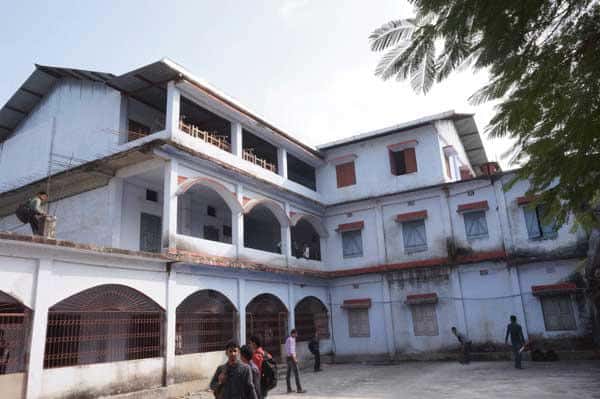
Netaji subhas mahavidyalaya
About
OfficialNetaji subhas mahavidyalaya is a other institution in Haldia, established in 1985. Netaji Subhas Mahavidyalaya (NSMC), located in Haldia, West Bengal, is a government-aided general degree college established in 1996. Named after the legendary freedom fighter Subhas Chandra Bose, the institution has steadily grown to become one of the significant educational hubs in the Purba Medinipur district. The college operates under the affiliation of Vidyasagar University and is recognized by the University Grants Commission (UGC). With over 2,800 students enrolled across undergraduate and postgraduate programs, NSMC serves as a crucial educational bridge for students from eastern India, particularly those from first-generation backgrounds seeking quality higher education at an affordable cost. The college's founding in 1996 came at a critical period when Haldia, a major petrochemical and industrial hub, required institutional support for workforce development. Over nearly three decades, NSMC has developed a reputation as a reliable institution focused on delivering competent graduates equipped for employment and further academic pursuits. The academic structure at NSMC is comprehensive, offering undergraduate honors and general degree programs in Sciences (Physics, Chemistry, Botany, Zoology, Mathematics), Commerce, and Arts (History, Political Science, English, Bengali). At the postgraduate level, the college offers Master's programs in select disciplines including Chemistry, Zoology, and History. The curriculum is regularly updated to align with Vidyasagar University standards and incorporates skill-based components to enhance employability. The college follows the semester-based evaluation system introduced under the National Education Policy framework, ensuring modern assessment practices. Research activities at NSMC remain modest but focused. Faculty members are engaged in research projects primarily in chemistry (organic synthesis, environmental chemistry), zoology (animal behavior, biodiversity), and history (regional history documentation). While the college does not operate dedicated research centers, individual faculty research is supported through departmental facilities and occasional university grants. Industry-academia partnerships are developing, particularly with chemical and petrochemical companies in Haldia's industrial belt, enabling student internships and practical exposure. Placement performance at NSMC is respectable though not exceptional. For the 2023-24 academic year, approximately 62% of graduating students secured placements, with median salaries ranging from 3.2 to 4.5 LPA depending on the discipline. Top recruiters include BPO firms (TCS BPO, Genpact, Sitel), banking and insurance companies (ICICI Bank, HDFC Bank, BSES), and manufacturing units in the Haldia industrial zone. Science graduates find better placement opportunities due to higher demand for chemistry and zoology graduates in research institutions and quality control labs. The college maintains a placement cell actively engaged with companies for campus recruitment, though the process is less structured compared to premier institutions. Campus infrastructure at NSMC is functional but requires modernization. The library houses approximately 18,000 books with limited digital resources; the situation has improved with partial access to INFLIBNET journals. Computer labs are equipped with approximately 120 computers with internet connectivity, though bandwidth limitations occasionally occur during peak hours. The science departments have basic laboratory equipment for undergraduate teaching, though some apparatuses are aging. The hostel facilities, while not luxurious, provide affordable accommodation with three-tier hostel blocks for both men and women. The college cafeteria serves basic vegetarian and non-vegetarian meals at subsidized rates. Sports facilities include a basketball court, volleyball court, and cricket field, though a dedicated gymnasium and swimming pool are absent. Campus Wi-Fi coverage remains patchy, primarily concentrated in the administrative block and library. The college does not operate transportation services; students rely on local buses and personal conveyance. Notable alumni of NSMC include several senior government officials, academics, and business professionals who have emerged from the institution, though comprehensive alumni tracking systems are underdeveloped. The college's strength lies in its affordability, accessibility, and contribution to democratizing higher education in eastern India. For first-generation learners and students from economically modest backgrounds, NSMC offers an excellent platform to pursue degree-level education without financial strain. The faculty, while not uniformly exceptional, includes dedicated educators committed to student development. The student body is diverse, representing urban and rural populations with varied socioeconomic backgrounds, creating a democratic learning environment. Challenges include limited research funding, inadequate digital infrastructure, moderate placement prospects compared to premier institutions, and limited industry engagement at scale. The college environment can feel slow-paced, which suits contemplative learners but may frustrate those seeking high-energy competitive ecosystems. Campus life is centered on academics with moderate engagement in cultural and sports activities through student clubs. The city of Haldia, while industrially developed, lacks the cosmopolitan amenities of larger metros, which some students find limiting. The institution is most suitable for: (1) First-generation learners seeking quality general degree education at minimal cost; (2) Students prioritizing academics and disciplined study over campus activities; (3) Science aspirants interested in chemistry and biology with modest placement aspirations; (4) Commerce and arts students targeting government jobs or further academic pursuits; (5) Local and regional students comfortable with the Haldia environment; (6) Students seeking a less competitive, collaborative learning environment; (7) Those with family or work commitments who need an institution close to home; (8) Aspirants for teaching or academic careers in tier-2 institutions. The college is less suitable for: highly ambitious students targeting top MNCs, those seeking world-class research facilities, students requiring extensive campus life and extracurricular engagement, and those planning higher studies at international universities requiring strong research exposure.