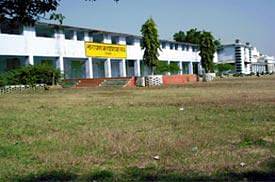
Narayan College
About
OfficialNarayan College is a other institution in Siwan, established in 1972. Narayan College, established in 1983, is one of Bihar's significant regional educational institutions located in Siwan district. Founded with the mission to provide quality higher education to students from Northern Bihar, the college has evolved from a modest liberal arts institution into a multi-disciplinary college offering undergraduate and postgraduate programs across Science, Commerce, and Humanities streams. The college operates under the affiliation of Jai Prakash University (JPU), Chapra, and serves a catchment area spanning multiple districts in Northern Bihar. The institution began with a focus on classical education in humanities and sciences but has progressively expanded its academic footprint. Over four decades, Narayan College has developed into a moderately well-resourced campus with dedicated departments for Physics, Chemistry, Biology, Mathematics, Zoology, Botany, English, Hindi, History, Geography, and Commerce. The college emphasizes foundational learning and provides a structured curriculum aligned with the Jai Prakash University examination pattern. Academic strengths are concentrated in Science subjects, where faculty members maintain reasonable expertise in Physics, Chemistry, and Mathematics. The college has established basic research facilities in Chemistry and Biology laboratories, allowing students to gain practical exposure in undergraduate experiments. Faculty members publish occasional research papers in regional and national journals, though research output remains modest compared to premier institutions. The institution does not have formal doctoral programs, focusing instead on strengthening undergraduate and master's-level education. Placement and career development have become increasingly important at Narayan College. The placement cell, restructured in 2022, actively engages with companies from nearby cities like Muzaffarpur, Patna, and occasionally Delhi-NCR regions. However, placement outcomes are moderate—approximately 40-45% of graduating students secure formal campus placements, with most positions in education, small-scale IT services, and retail sectors. Salary packages average 2.5-3.5 LPA for engineering/science graduates and 1.8-2.4 LPA for commerce graduates. The college has established relationships with 35-40 organizations for recruitment drives, though these are primarily regional rather than national enterprises. Campus infrastructure reflects the college's suburban location and regional focus. The 28-acre campus includes a library with approximately 45,000 volumes, science laboratories with functional but aging equipment, computer centers with 150+ systems, a small sports complex, and sports fields for cricket, volleyball, and badminton. The hostel facilities accommodate approximately 800 students, with separate facilities for women. Internet connectivity is available across campus with moderate bandwidth (15-20 Mbps), though connectivity during peak hours can be inconsistent. The administrative building, academic blocks, and student amenities are adequately maintained but show signs of aging infrastructure. Student life at Narayan College reflects the character of a regional institution with significant first-generation college-goer representation. The student body is diverse, with approximately 65% from rural backgrounds and 70% belonging to OBC/SC/ST/EWS categories. Cultural events are organized, including an annual college fest, sports day, and departmental functions. Student clubs exist for academics, cultural activities, and sports, though organizational capacity is limited compared to metropolitan institutions. The college has reported minimal ragging incidents and maintains gender-sensitive policies, contributing to a relatively safe campus environment. What distinguishes Narayan College is its role as an accessible educational gateway for Northern Bihar students who might not have access to better-resourced institutions. The college provides practical value through affordable education (annual fees under 40,000 INR for most programs), proximity to student hometowns, and faculty members who understand regional educational needs. For first-generation learners aspiring to pursue higher education in a familiar environment before considering postgraduate studies elsewhere, the college offers a structured, cost-effective foundation. The institution is best suited for students seeking: (1) Affordable undergraduate education in Science, Commerce, and Humanities from Northern Bihar; (2) A structured, conventional academic environment without the intensity of IIT/NIT preparation; (3) Practical laboratory experience in sciences before considering specialization; (4) Campus placement support, though with realistic salary expectations; (5) A student community reflective of rural and semi-urban India. The college is less suitable for students seeking cutting-edge research facilities, metropolitan exposure, or highly competitive placement environments. Students should have realistic expectations about infrastructure quality, faculty research output, and placement outcomes while appreciating the college's role in democratizing higher education access in an underserved region.