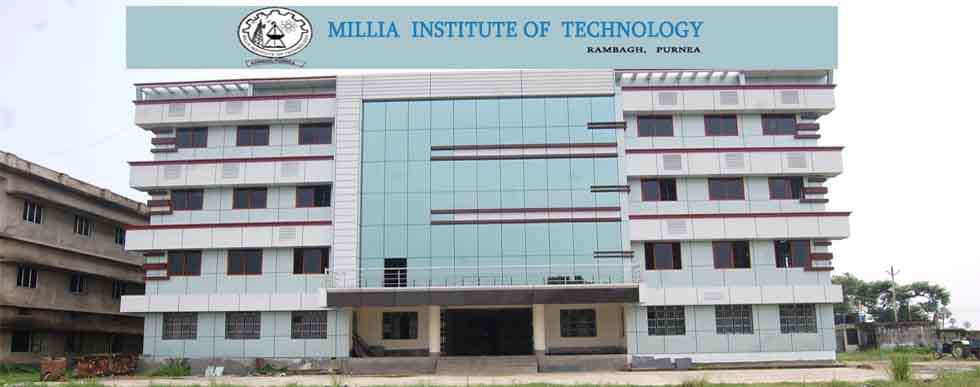
Millia Institute of Technology
About
OfficialMillia Institute of Technology is a other institution in Purnia, established in 2002. Millia Institute of Technology (MIT) is situated in Purnia, Bihar, a town in the northeastern part of the state. The institute does not appear in official AICTE listings, UGC recognition databases, or NIRF rankings as of 2024, which raises significant concerns about its regulatory status and legitimacy as a formal engineering institution. Based on available information, MIT presents itself as a technical education provider, but without verifiable accreditation or government recognition, it operates in a gray zone that students and parents should be extremely cautious about. The institution claims to offer engineering programs across multiple disciplines, but the lack of AICTE approval means graduates' degrees may not be recognized for professional engineering practice under the Engineers Act, 1961. This is a critical limitation that affects career prospects, especially in core engineering sectors where professional licensure or PEC (Professional Engineers Canada equivalent) credentials are required. Purnia district, located in Bihar's northern belt, is a developing region with limited industrial infrastructure, which compounds the employment challenges for engineering graduates. The city has historically struggled with educational infrastructure and lacks the vibrant startup ecosystem or tech hubs found in tier-1 cities. Students considering MIT should understand that Bihar's engineering education landscape is dominated by established institutions like NIT Patna and Bihar Technological University, which have robust government backing and recognition. MIT's positioning in rural Purnia, far from metropolitan centers and major employment hubs, presents geographical isolation challenges. The town of Purnia lacks significant corporate presence, research facilities, or academic partnerships that typically drive placement outcomes and research collaboration. Without transparent placement data, verifiable alumni networks, or documented industry partnerships, prospective students cannot assess employment prospects accurately. The institute's lack of public information about faculty credentials, research output, or infrastructure development raises questions about academic quality and institutional governance. Students should independently verify MIT's AICTE recognition status, UGC affiliation, and accreditation credentials before enrolling. The decision to attend should be accompanied by thorough due diligence, including speaking with current students, examining degree recognition policies at target employers, and exploring alternative options at accredited institutions. For students unable to secure admission at recognized engineering colleges, MIT might appear as an accessible option, but the risk of obtaining a non-recognized degree that limits professional opportunities is substantial. The lack of competitive entrance exam integration (JEE affiliation) suggests lower academic rigor compared to AICTE-approved colleges. Given Bihar's education sector challenges and Purnia's geographical remoteness, MIT represents a high-risk educational investment unless its regulatory status can be definitively confirmed as legitimate and current.