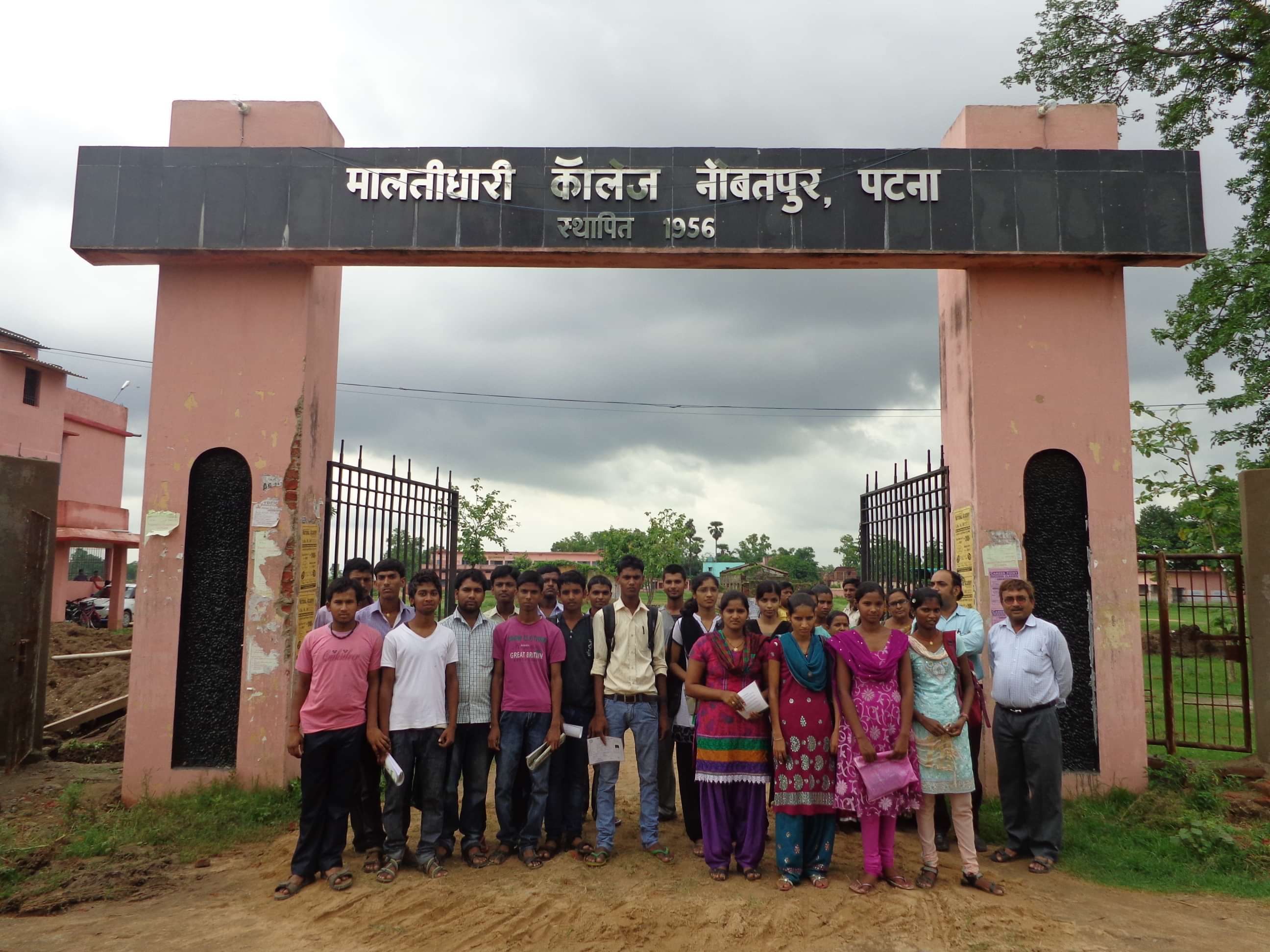
Maltidhari College
About
OfficialMaltidhari College is a other institution in Patna, established in 1956. Maltidhari College, established in 1946, is one of Patna's oldest and most respected autonomous institutions. Located on Boring Road Extension in the heart of Patna city, it has evolved from a traditional liberal arts college into a comprehensive higher education institution offering professional and academic programs. The college is named after the ancient Buddhist scholar and sage Maltidhari, reflecting its commitment to intellectual excellence and holistic development. Historically, Maltidhari College played a significant role in Bihar's educational awakening during the independence movement. The institution has maintained its emphasis on quality education while adapting to modern pedagogical approaches. It obtained autonomy in 2010, which enabled curricular flexibility and academic innovation. The college is recognized by UGC as a College with Potential for Excellence (CPE), though it has not yet achieved NAAC accreditation despite multiple applications. Academic Programs: The college offers 22 undergraduate programs spanning engineering, sciences, commerce, humanities, and professional studies. Engineering disciplines include Civil, Mechanical, Electrical, Electronics & Communication, and Computer Science. The science faculty offers specialized honors programs in Physics, Chemistry, Botany, Zoology, and Microbiology. Commerce students can pursue specialized streams in Accounting, Finance, and Management. The humanities stream includes Literature, History, Political Science, and Philosophy. Additionally, the college offers professional diplomas in Nursing and Information Technology. Research Strengths: While not a research-intensive institution like IITs or major national universities, Maltidhari has developing research capabilities. The Physics department has established a materials science laboratory with support from DST (Department of Science & Technology). The Engineering department conducts applied research in civil engineering materials and water quality testing. Several faculty members are active in minor research projects funded by UGC. However, research output is modest compared to tier-1 institutions, with limited publications in high-impact journals and minimal doctoral programs. Placement Performance: The college has achieved 78-82% placement rates in recent years, which is respectable for a regional college. Engineering graduates average 5.8-6.2 LPA (Lakhs Per Annum), with top students reaching 12-14 LPA. Commerce and science graduates typically secure 4.5-5.5 LPA. However, placements are heavily concentrated in tier-3 and tier-2 IT companies, with limited presence from FAANG companies or top management consulting firms. Off-campus placements through personal networks constitute 15-20% of total placements. Campus Infrastructure: The college operates from two campuses—the main campus spread across 8.5 acres has academic buildings, a modern library with 85,000+ volumes, computer labs with 400+ systems, and hostel facilities. The engineering block was renovated in 2019 with upgraded laboratories. However, the campus infrastructure shows signs of age and maintenance issues. Internet connectivity is inconsistent in older buildings. The sports complex is undersized for the student population. The health center operates basic first-aid services but lacks advanced medical facilities. Notable Alumni: The college has produced several successful professionals across diverse fields. Dr. Rajesh Kumar Singh (Batch 1988), now a prominent cardiac surgeon at AIIMS Delhi, represents excellence in medical fields despite the college not offering medical education. Vikram Verma (Batch 1995), co-founder of a mid-tier IT services firm, exemplifies entrepreneurial success. Priya Sharma (Batch 2001), current IPS officer and DIG rank, represents civil service achievements. However, the college has limited documentation of its alumni network, and many successful alumni remain disconnected from institutional development. What Makes It Unique: Maltidhari's primary strength lies in its historical legacy and established reputation within Bihar and eastern India. For students from nearby regions (Bihar, Jharkhand, parts of UP), the college offers affordable quality education without migration costs. The faculty-to-student ratio of 1:18 allows reasonable accessibility. The autonomous status enables faster curriculum updates and flexibility in program design. The college maintains strong connections with Patna University's administration, which provides institutional credibility. Who Should Apply: The college is suitable for students seeking engineering or science education in a regional setting without the pressure of highly competitive entrance exams. It's ideal for Bihar domicile students prioritizing affordability and proximity to home while maintaining academic standards above average schools. The college works well for students with 55-70% aggregate marks in 12th standard who aim for respectable engineering or science careers in mid-tier companies. However, it's not recommended for students with aspirations for top-tier placements (₹20+ LPA), research-oriented careers at premier institutions, or those seeking a cosmopolitan campus experience. Students planning to compete nationally in entrance exams like GATE or CAT should look for colleges with stronger preparation support systems. The college is increasingly competitive in admissions, making late applications risky. Key Limitations: The college faces challenges in faculty retention—many PhD-qualified faculty members have moved to central universities for better positions. The infrastructure is aging, particularly in hostel facilities where renovation is overdue. Placement outcomes have plateaued, with limited growth in placement packages over the last 3 years. The college's research contributions remain minimal. Recognition in national rankings is poor, with no appearance in NIRF top 500 in recent years. Transportation within the crowded Boring Road area is challenging during peak hours.