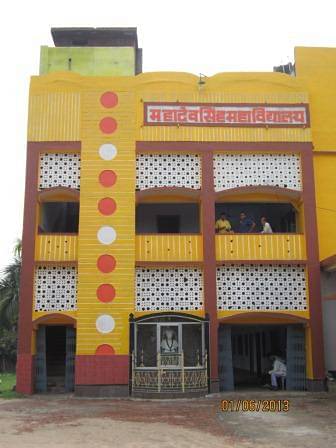
Mahadeo Singh College
About
OfficialMahadeo Singh College is a other institution in Bhagalpur, established in 1983. Mahadeo Singh College (MSC) was established in 1952 in Bhagalpur, Bihar, as a general degree college with the mission to provide quality higher education to students from the Gangetic plains and surrounding regions. Named after the philanthropist Mahadeo Singh, the institution has grown from a modest two-stream college offering arts and science streams to a multi-disciplinary institution serving nearly 2,850 students across undergraduate and postgraduate programs. The college operates under the affiliation of Bhagalpur University and maintains recognition from the UGC as a Category-I college eligible for developmental grants and research funding. Historically, Bhagalpur was an intellectual hub during the independence movement, and MSC positioned itself as an institution committed to grooming socially conscious citizens alongside academic excellence. The college's 18.5-acre campus, spread across the Tilka Manjhi Road area (named after the tribal freedom fighter), provides a serene learning environment away from the city's commercial hub while remaining accessible to essential services. MSC's academic structure encompasses three main streams: Science (Physics, Chemistry, Biology, Mathematics), Arts (History, Geography, Political Science, Economics, English, Hindi, Sanskrit), and Commerce (Accounting, Economics, Business Studies). At the postgraduate level, the college offers MA in History, MA in Political Science, M.Com in Commerce, and MSc in Physics and Chemistry. The college has recently introduced a BA-BEd integrated program in response to the National Education Policy 2020, recognizing the critical shortage of quality teachers in Bihar. The science stream maintains traditional laboratory infrastructure including physics labs for mechanics and optics, chemistry labs for organic and inorganic synthesis, and biology labs equipped for histology and microbiology practicals. However, the outdated equipment in some labs (some dating back 15-20 years) means practicals sometimes feel less engaging compared to better-funded institutions. The college library holds approximately 45,000 volumes including journals, rare manuscripts on Bhagalpur's local history, and digital access to JSTOR and Scopus databases (access shared with other affiliated colleges in the university). Internet connectivity in the library is reliable but campus-wide WiFi coverage remains patchy, particularly in older buildings constructed in the 1970s. The institution has produced several civil servants, academics, and professionals who serve in government and private sectors, though the alumni network outside Bihar remains limited compared to metropolitan colleges. Research output has increased modestly in recent years, with 3-4 faculty members publishing regularly in peer-reviewed journals, primarily in chemistry and history. The college maintains partnerships with government schools in Bhagalpur for teacher training initiatives and runs extension programs addressing rural agricultural literacy. Placements for science graduates historically cluster around government job coaching (UPSC, SSC, State PSC) and conventional employment in education and administration. Commerce graduates find placement in accounting firms, GST consultancy, and banking sector, though the median salary remains modest at 280,000-350,000 INR annually due to the regional economic context. Arts stream students primarily pursue civil service preparation, teaching, or journalism. The college struggles with infrastructure limitations typical of tier-3 city institutions: power cuts lasting 3-4 hours during summer, erratic water supply, and limited sports facilities compared to better-funded NIT/IIT satellite campuses. The campus culture emphasizes traditional academic values and social responsibility. Student activism is visible around educational policy and local community issues. The college hosts an annual cultural fest (Mahotsav) in November attracting participation from surrounding colleges, a science symposium focusing on research dissemination, and annual sports meet featuring cricket, volleyball, and athletics. NSS (National Service Scheme) programs are active, with students regularly engaged in village development drives, sanitation campaigns, and literacy initiatives. The gender ratio stands at approximately 45% women, with women's hostels maintained separately, though safety concerns around campus security (particularly for evening classes) have been raised in student feedback. The college administration has been responsive to such concerns, introducing better gate security and escort services. Student-faculty rapport is generally warm, with most senior faculty maintaining open door policies, though teaching methods remain largely traditional lecture-based with limited use of active learning pedagogies or online tools. The institution appeals most to students seeking affordable quality education in a small-city environment, those preparing for competitive exams with focused coaching support, and students from Bhagalpur and adjoining districts prioritizing proximity to home. It is less suited for students seeking cutting-edge research facilities, rapid industry placement in technology sectors, or cosmopolitan campus culture. The college's unique strength lies in its deep community rootedness, strong connections with government institutions in Bihar, and emphasis on values-based education. Governance is participatory, with regular student representation in academic committees, though infrastructure development has been slow due to limited government funding allocation to non-priority colleges.