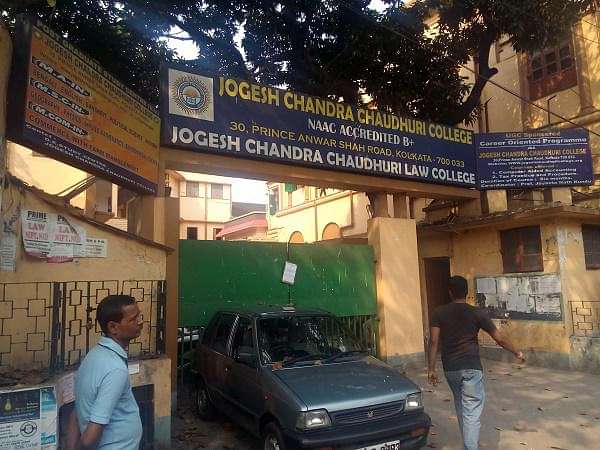
Jogesh Chandra Chaudhuri College
About
OfficialJogesh Chandra Chaudhuri College is a other institution in Kolkata, established in 1965. Jogesh Chandra Chaudhuri College, established in 1989, stands as one of Kolkata's premier liberal arts and science institutions, located in the heart of the city on A.P.C. Road. Named after the renowned educationist and freedom fighter, the college embodies a legacy of academic excellence and social responsibility. Founded with the vision of providing quality higher education to merit-based students across socioeconomic backgrounds, JCC has evolved into a multi-disciplinary institution offering undergraduate and postgraduate programs spanning Sciences, Arts, Commerce, and Humanities. The college's academic structure comprises the Department of Physics, Chemistry, Biology, Mathematics, English, History, Political Science, Economics, Philosophy, and Commerce, each led by accomplished faculty members with advanced degrees from Indian and international universities. The college maintains affiliation with the University of Calcutta and operates under the regulatory framework of the University Grants Commission (UGC). Research strengths lie particularly in experimental sciences—physics research focuses on condensed matter physics and semiconductor devices, while chemistry laboratories conduct work in organic synthesis and materials science. The biology department maintains active research in molecular biology and environmental microbiology. Several faculty members have published in peer-reviewed international journals, though research output remains modest compared to premier central universities. The college has established industry partnerships with pharmaceutical companies for applied chemistry research and with tech firms for computer science applications. Academic programs include B.Sc. (Honors) in Physics, Chemistry, Biology, and Mathematics; B.A. (Honors) in English, History, Political Science, and Economics; B.Com. (Honors); B.Sc. (General) in Science; and B.A. (General) in Arts. Postgraduate offerings include M.Sc. programs in Physics, Chemistry, and Biology, and M.A. programs in English and History. The college also offers diploma and certificate courses in computer applications and environmental studies. All undergraduate programs follow the Choice-Based Credit System (CBCS) as per University of Calcutta guidelines, allowing students flexibility in course selection. The typical undergraduate program spans 3 years (6 semesters) with honors specialization requiring additional coursework. Placement records show improving trends with 2023-24 academic year recording approximately 68% placement rates among graduating students. While not matching IIT/AIIMS benchmarks, the college has successfully placed graduates in software development companies (TCS, Infosys, Wipro), financial services (ICICI, HDFC), pharmaceutical firms, and teaching institutions. Average salary packages for science graduates range from 3.5-5.5 lakhs annually, with commerce graduates securing 4-6 lakhs. However, placement heavily favors computer science and commerce graduates; pure science stream students often pursue higher education instead. The placement cell operates with moderate resources and relies substantially on campus walks-in rather than proactive industry outreach. Campus infrastructure reflects urban constraints with limited land area—approximately 2.5 acres in a congested Kolkata locality. The main building houses classrooms, laboratories, and administrative offices, while a separate annex accommodates additional departments. Science laboratories are reasonably equipped with microscopes, spectrophotometers, and standard teaching apparatus, though equipment ages. The college library holds approximately 45,000 books with a modest collection of journals and online databases including JSTOR access. Wi-Fi coverage extends across campus but experiences occasional bandwidth limitations during peak hours. Lack of significant green space and outdoor sports facilities presents a notable limitation; the college relies on a small courtyard for assemblies and relies on nearby public grounds for sports training. Student life encompasses approximately 2,800 enrolled students across all programs. The college actively fosters a vibrant academic and cultural environment through multiple student clubs including Science Club, Debating Society, Cultural Association, and Social Service Wing. Annual fests include Scientifica (science fest in November), Kaleidoscope (cultural fest in February), and inter-departmental sports tournaments. The college encourages participation in University of Calcutta-sponsored competitions and has produced several merit scholars in competitive examinations. However, student activism and engagement vary significantly—strong participation from honors stream students while general stream engagement remains moderate. Hostel facilities accommodate approximately 400 students across separate men's and women's hostels located within college premises and in nearby rented buildings. Hostel standards reflect institutional budgets—basic but functional with shared rooms (3-4 occupants), common study areas, and mess facilities. Wi-Fi connectivity in hostels remains inconsistent. The college mess provides vegetarian and non-vegetarian options with basic nutritional standards; monthly charges range from 2,500-3,500 INR. Many students prefer off-campus accommodations in nearby areas like Entally, Bhawanipur, and South Kolkata, where shared flats rent for 8,000-15,000 INR monthly. Faculty composition comprises 145 members across all departments, with approximately 65% holding Master's degrees and 35% possessing doctorates. Faculty research output remains limited with only 12-15 publications in indexed journals annually across the institution. However, several senior professors maintain active engagement with professional associations and conduct mentoring programs. Faculty-student interaction is generally accessible; most professors maintain office hours and provide academic guidance. Teaching methodology emphasizes classroom lectures supplemented by laboratory sessions; interactive teaching and research participation for undergraduates remain limited. Admissions operate on merit-based selection through University of Calcutta's merit list system for state students. Honors programs in Science and Commerce are highly competitive with cutoff marks typically requiring 75-85% in 10+2 final examination depending on category and stream. Arts honors programs are less competitive with cutoffs around 65-75%. General program admissions are relatively open with cutoffs near 50%. The college follows University of Calcutta's reservation policies—OBC (27%), SC (13%), ST (6%), PWD (3%), and EWS (10%) quotas. Application process involves online registration on the university portal followed by document verification at the college. Notable alumni include journalists, academic researchers, civil servants, and business professionals. Banerjee Sharmistha (Batch 2005, Development Economist at World Bank), Mukherjee Anirban (Batch 1995, UPSC Civil Services), and Ghosh Priya (Batch 2008, Senior Journalist at Indian Express) represent diverse career trajectories. The alumni association, though modest, maintains periodic reunions and mentoring programs. The college's unique positioning lies in providing affordable, quality education in the heart of metropolitan Kolkata with reasonable academic standards and a socially conscious student body. It attracts merit-seeking students from lower-middle and middle-class backgrounds who value proximity to the city and access to cultural institutions. The college suits students seeking a balanced education rather than ultra-competitive specialization, those interested in humanities and social sciences, and those unable to relocate to other cities. However, it is not the optimal choice for students targeting elite graduate programs abroad (limited research exposure), pure science enthusiasts (modest laboratory facilities), or those seeking luxurious campus amenities. The institution represents mainstream Indian collegiate education—functional, accessible, and reasonably effective for career initiation, though not exceptional in research or global recognition.