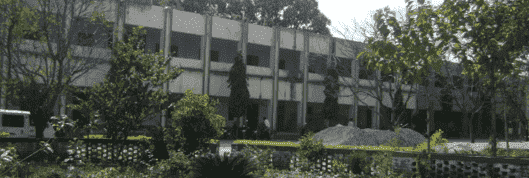
J.L.N. College
About
OfficialJ.L.N. College is a other institution in Rohtas, established in 1962. J.L.N. College, established in 1969 in Sasaram, Rohtas District, Bihar, is one of the region's most significant higher education institutions. Founded by Shri Jagat Pal Singh with a vision to democratize quality education in underdeveloped areas of Bihar, the college has evolved into a multi-disciplinary institution serving nearly 3,000 students across 15 academic departments. The college is affiliated with Veer Kunwar Singh University (formerly Aryabhata Knowledge University) and operates under UGC guidelines with NAAC accreditation (Grade B, valid until 2027). The institution offers undergraduate and postgraduate programs across Engineering, Sciences, Commerce, Arts & Humanities, and Law disciplines. The Engineering section, established in 1985, provides bachelor's degrees in Civil, Mechanical, and Electrical Engineering with a combined intake of 180 students annually. The Science faculty comprises departments of Physics, Chemistry, Botany, Zoology, and Mathematics, collectively serving 450+ students. The Commerce and Arts streams cater to approximately 1,200 students pursuing BA, BCom, MA, and MCom degrees. Academically, the college emphasizes foundational learning with faculty members holding PhD qualifications from reputed Indian universities. The student-faculty ratio stands at approximately 15:1, allowing reasonable access to teaching staff. However, research output remains limited, with only 12% faculty members actively engaged in research publications and minimal sponsored research projects. The college library houses approximately 85,000 volumes with subscription to 40 national and international journals, though digital access remains restricted compared to tier-1 institutions. Placements have shown gradual improvement over the past three years, with 2023-24 recording 62% placement rate among eligible graduates. IT companies including TCS, Wipro, and HCL Technologies have been consistent recruiters, alongside government sectors like Railways and SSC. However, placement infrastructure remains nascent—the dedicated placement cell operates with a single full-time coordinator, limiting proactive industry engagement. Average salary for 2023-24 graduates stood at approximately ₹3.8 lakhs annually, with highest salaries around ₹12 lakhs secured by top performers in core technical roles. Campus infrastructure reflects institutional age and resource constraints. Hostels accommodate approximately 40% of students, with separate facilities for men and women. The men's hostel houses 400 students in basic but functional conditions; the women's hostel (added in 2010) accommodates 200 with marginally better amenities. Campus WiFi coverage reaches roughly 70% of the area with inconsistent speed (4-8 Mbps). The sports complex includes a cricket ground, volleyball court, and badminton facilities, though maintenance issues are frequent. A state-of-the-art health center was inaugurated in 2022 with basic diagnostic facilities and resident nurse staff. Student life revolves around annual college festivals—Janmejay (cultural fest, March) and Technofair (technical fest, October)—which draw participation from neighboring institutions. The college hosts 28 student clubs spanning technical societies (coding, robotics, electronics), cultural groups (drama, music, debate), and sports teams. However, extracurricular engagement remains moderate due to limited sponsorships and mentoring. The college has reported no confirmed ragging incidents in the past five years, with a zero-tolerance institutional policy and regular student orientation programs. Sasaram, where the college is located, is a tier-3 city in Rohtas District with limited corporate presence but strong government sector employment opportunities. The city lies approximately 160 km from Patna and 600 km from Delhi, accessible via both road and rail. Living costs remain significantly lower than metros—monthly budgets for students range from ₹8,000-12,000 (budget category) to ₹15,000-18,000 (comfortable). The local environment is predominantly agrarian with emerging small-scale industries, limiting off-campus placement prospects but reducing living expenses substantially. Notable alumni include IAS officer Rajesh Kumar (2001 batch), who currently serves as District Commissioner in Uttarakhand; Dr. Arun Singh (1995 batch), Professor of Electrical Engineering at IIT Bombay; and Deepak Yadav (2004 batch), CEO of a mid-sized IT consulting firm in Bangalore. While the alumni network lacks the prominence of tier-1 institutions, there is meaningful engagement in government sectors and academia. The college is ideal for students from Bihar, Uttar Pradesh, and Eastern India seeking quality education at significantly lower costs than metropolitan institutions, with exposure to foundational academics and moderate placement prospects. It suits aspirants prioritizing accessibility, affordable living, and government job preparation over premium campus experiences. Students should enter with realistic expectations about research opportunities and corporate placement volumes, but will benefit from close faculty interaction and a values-oriented institutional culture emphasizing discipline and inclusive development.