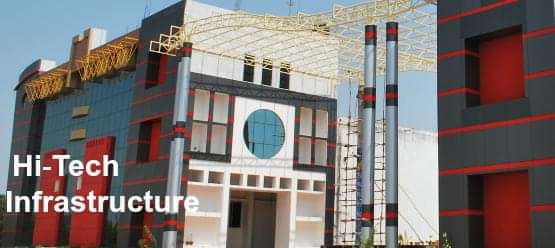
Hi-Tech Institute Of Technology, Aurangabad
About
OfficialHi-Tech Institute Of Technology, Aurangabad is a other institution in Aurangabad, established in 2001. Hi-Tech Institute of Technology (HITEC), Aurangabad, established in 2000, is a private engineering institution located in the historic city of Aurangabad, Maharashtra. Founded by the Deogaon Education Trust, the institute has positioned itself as a regional engineering college serving Maharashtra and surrounding states. Over its 24-year history, HITEC has evolved from a modest single-discipline engineering college into a multi-disciplinary institution offering undergraduate and postgraduate programs across engineering, sciences, and technology domains. The institute's vision centers on producing technically competent, ethically sound engineers capable of addressing real-world challenges while maintaining social responsibility. With a current enrollment of approximately 2,800 students and 185 faculty members distributed across eight undergraduate branches and four postgraduate specializations, HITEC serves a predominantly lower-middle to middle-class student demographic, many of whom are first-generation learners from tier-2 cities and rural Maharashtra. The campus, spanning 25 acres on Paithan Road, combines modern academic infrastructure with hostel facilities designed to accommodate students from across India. Academically, HITEC offers B.Tech programs in Civil, Mechanical, Electrical, Electronics & Communication, Computer Science, Chemical, Production, and Information Technology disciplines, each with intake capacities ranging from 60-120 students per year. The M.Tech programs in Computer Science, Thermal Engineering, and Civil (Infrastructure Engineering) attract students primarily from Maharashtra and neighboring states. The institute's academic approach balances theoretical foundations with hands-on laboratory work, though infrastructure limitations occasionally constrain experiential learning. Faculty holds credentials from various universities, with approximately 35% possessing PhDs, primarily from Indian institutions. Research activities remain modest, focusing on applied engineering domains including structural optimization, renewable energy, IoT applications, and water treatment technologies, though publication outputs in high-impact journals remain limited. The placement ecosystem has shown steady improvement, with 2023-24 recordings showing 82-85% placement rates for engineering graduates, median salaries in the 4.5-5.8 LPA range, and growing interest from tier-2 IT companies, core engineering firms, and emerging startups. Notable recruiters include Infosys, TCS, Wipro, HDFC Bank, Bajaj Auto, L&T Infotech, HCL Technologies, and various State Bank entities, though placement concentration remains heavily skewed toward IT services rather than core engineering or specialized roles. The institute hosts an annual technical festival (TechnoVision) attracting 2,000+ participants, cultural festival (Synergy) showcasing diverse student talents, and sports day competitions. Student clubs operate in technical (IEEE, SAE, CSI chapters), cultural, and sports domains, though participation rates are moderate. Campus life revolves around hostel communities, particularly for students from non-local backgrounds—approximately 65% of enrollment. The hostel environment is predominantly described as functional and cost-effective rather than luxurious, with shared rooms (2-3 occupancy) and basic amenities. Internet connectivity campus-wide operates at 15-20 Mbps, adequate for academic purposes but occasionally insufficient for video conferencing at peak hours. Safety for women students is reportedly good, with separate hostel blocks, boundary security, and CCTV coverage, though social constraints typical of smaller cities occasionally limit freedom of movement during evening hours. Ragging has been minimal in recent years due to strict institutional policies and senior student awareness. The institution's value proposition lies in its affordable fee structure (total 4-year B.Tech cost approximately 12-16 LPA), location in a historically and culturally significant city, and focus on producing employable engineers from modest socioeconomic backgrounds. Academic rigor is moderate—while curricula align with AICTE standards, peer comparison to tier-1 NITs reveals gaps in research depth, faculty credentials, and placement package distribution. Infrastructure includes dedicated computer labs (1:2 student-to-system ratio), physics and chemistry labs, civil engineering testing facilities, and a central library housing approximately 32,000 volumes plus digital access to IEEE Xplore and Scopus databases. The institute faces challenges including limited industry-academia research collaboration, moderate campus placement infrastructure, occasional curriculum lag behind technology evolution, and geographic isolation from metropolitan employment hubs—factors that occasionally necessitate student relocation post-graduation. HITEC is recommended for students from smaller towns and rural Maharashtra seeking affordable, accessible engineering education with reasonable placement prospects, particularly those unable to secure admission to NIT/IIIT institutions or seeking alternative engineering pathways outside competitive tier-1 colleges. The institution appeals to aspiring engineers willing to invest personal effort in skill development through internships and self-directed learning, as institutional support systems, while present, require student initiative to fully leverage. First-generation learners, women engineers entering male-dominated technical fields, and students prioritizing cost-effectiveness over prestige represent the college's core demographic strength. However, ambitious students targeting multinational IT placements, specialized research careers, or premium core engineering roles at large manufacturers should carefully evaluate HITEC against metropolitan alternatives, as network effects and recruiting concentration remain skewed toward tier-2 companies and service-based roles.