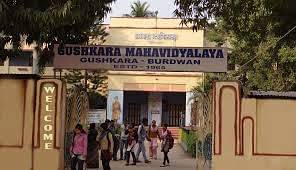
Gushkara Mahavidyalaya
About
OfficialGushkara Mahavidyalaya is a other institution in Burdwan, established in 1965. Gushkara Mahavidyalaya is a government-aided undergraduate and postgraduate college located in the quiet village of Gushkara in Burdwan District, West Bengal, approximately 45 kilometers from Kolkata. Established in 1968, the institution has evolved into a respectable regional college serving students primarily from West Bengal and neighboring states. The college operates under the affiliation of Burdwan University (now renamed Sidho-Kanho-Birsha University) and offers a diverse range of undergraduate and postgraduate programs across Arts, Science, and Commerce disciplines. With a student body of approximately 2,800 and a teaching faculty of 95 members, the institution maintains an intimate academic environment while grappling with typical challenges of rural educational infrastructure. The college's primary strength lies in its accessibility to economically disadvantaged and first-generation college students who seek quality higher education without the premium costs associated with urban private institutions. The academic programs are traditional and curriculum-focused rather than research-intensive, with a significant emphasis on classical humanities, social sciences, and basic sciences. The institution does not offer engineering, management, or professional programs like law or medicine, which limits its appeal to students seeking specialized higher education. Faculty members are primarily doctorate-holders in their respective disciplines, though research output and publication rates remain modest compared to metropolitan institutions. The college has developed modest laboratory facilities for science stream students and a functioning library with approximately 35,000 books. Infrastructure development has been gradual, with recent additions including a computer lab and improved Wi-Fi connectivity in select academic blocks. The placement landscape is constrained by the rural location and the non-technical nature of programs offered. Graduate students primarily move into teaching, civil service preparation, or pursue further education through postgraduate programs at larger universities. The college culture emphasizes traditional pedagogy and student discipline, with a relatively conservative social environment. Campus life is quieter than urban colleges, with limited entertainment and shopping infrastructure nearby, though this appeals to students seeking focused academic environments. Notable strengths include affordable fee structures, strong local community connections, dedicated faculty in certain departments, and a peaceful campus setting conducive to serious study. Significant challenges include limited placement opportunities for non-teaching careers, outdated academic infrastructure in some departments, insufficient research facilities, limited exposure to emerging fields like data science or digital humanities, and geographic isolation that restricts industry networking and internship opportunities. The institution is recommended for students seeking affordable undergraduate or postgraduate education in liberal arts disciplines, particularly first-generation learners and those preparing for civil service examinations. It is not suitable for students pursuing engineering, technology, or management careers, or those prioritizing placement-driven education. The college's alumni network, while functional, lacks the professional reach of metropolitan institutions, limiting networking benefits for career advancement.