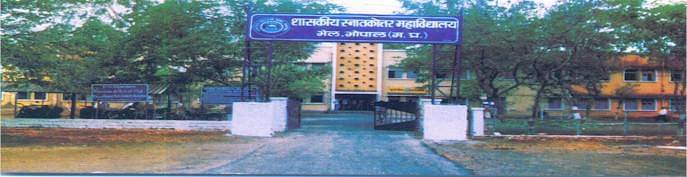
Government PG College BHEL
About
OfficialGovernment PG College BHEL is a public institution in Bhopal, established in 1956. Government PG College BHEL (GPCB), established in 1978, stands as one of Madhya Pradesh's premier postgraduate institutions, strategically located within the BHEL township area of Bhopal. Founded during India's industrial expansion, the college was created to serve the educational needs of engineering professionals and scientists working in the Bharat Heavy Electricals Limited complex, though it has since evolved into a comprehensive academic institution welcoming students from across the state and nation. The college's inception coincided with BHEL's golden era, creating a natural synergy between academic rigor and industrial relevance that persists today. The institution operates under the Government of Madhya Pradesh's higher education framework while maintaining autonomous academic standards recognized by the University Grants Commission. GPCB specializes in postgraduate education across engineering disciplines, sciences, and management studies, deliberately positioning itself as a bridge between theoretical knowledge and industrial application. The campus, spanning 18 acres within the secure BHEL township, benefits from exceptional infrastructure inherited from its industrial surroundings—reliable power supply, maintained roads, security systems, and institutional discipline uncommon in typical college settings. The college houses dedicated research facilities including materials testing laboratories, electrical engineering simulation centers, and chemistry research wings that serve both academic and consulting purposes. Faculty strength of 145 members includes 68% with PhDs, many holding additional qualifications from IITs and international universities. The college maintains active research collaborations with BHEL's R&D division, leveraging access to industrial equipment for student projects and thesis work. Academic programs span M.Tech. in Power Systems, Thermal Engineering, Electrical Engineering, and Advanced Materials; M.Sc. in Physics, Chemistry, and Mathematics; MBA; and M.A. in English and Economics. The M.Tech. programs particularly benefit from BHEL's proximity—students conduct internships and projects within operational power plants, thermal stations, and research facilities, providing practical exposure uncommon in purely academic institutions. The college's placement record reflects steady improvement, with 78-82% placement rates in recent years, primarily in power sector companies (NTPC, BHEL, Reliance Power), IT firms (TCS, Infosys, Wipro), and research organizations (CSIR labs, BARC). However, honest assessment reveals constraints: the college's industrial proximity, while beneficial for some disciplines, creates perception challenges for management graduates competing with IIMs and reputed business schools. The MBA program, though well-structured, lacks the brand recognition and corporate recruiter depth of tier-1 B-schools—average MBA salaries hover around 8-10 LPA compared to 15-20 LPA at top institutions. Science program placements are substantially lower (35-45%) as graduates typically pursue doctoral studies or government positions. The college faces resource constraints in humanities and social sciences disciplines, with limited library collections and outdated computing facilities for non-engineering departments. Hostel infrastructure accommodates approximately 40% of student population; remaining students seek private accommodation in Bhopal's PG markets, adding 6,000-10,000 INR monthly to living costs. Internet connectivity, despite BHEL township infrastructure, remains inconsistent within hostel areas due to aging network infrastructure—bandwidth constraints occasionally affect online learning delivery. Campus culture emphasizes academic seriousness over extracurricular vibrancy; technical clubs remain active while cultural societies struggle with consistent student participation. The college maintains strict discipline standards inherited from government institutional norms, which some students experience as restrictive but others value for focus-oriented study environment. Faculty-student interaction quality varies significantly across departments; senior professors demonstrate exceptional mentorship while junior faculty often remain overloaded with administrative duties. The city location in Bhopal presents mixed advantages: excellent air connectivity (Rajmata Vijayaraje Scindia Airport 10km away), railway access, and cost-effective living compared to metros, but limited nightlife, entertainment options, and job market for spouses compared to metros or tech hubs. GPCB suits ambitious postgraduate students prioritizing industrial exposure, research-oriented education, and cost-effectiveness over brand reputation and campus lifestyle. Ideal candidates include working professionals seeking part-time M.Tech., engineering graduates from tier-2 colleges aspiring to BHEL/NTPC careers, science graduates pursuing research paths, and students valuing practical engineering education over networking opportunities. The institution explicitly does not position itself as a stepping stone to premium corporates or startups—it excels at producing competent engineers for core sectors and research scholars.