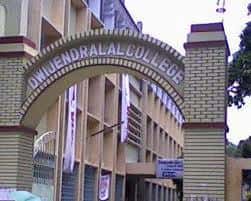
Dwijendralal College
About
OfficialDwijendralal College is a other institution in Nadia, established in 1968. Dwijendralal College, established in 1905 in Krishnanagar, Nadia district, West Bengal, stands as one of the oldest educational institutions in the Nadia region with over a century of academic heritage. The college was founded with the vision of providing quality higher education to students from surrounding rural and semi-urban areas, and it has evolved into a respectable institution serving approximately 2,800 undergraduate and postgraduate students across diverse disciplines. The campus sprawls across 12.5 acres in a relatively quiet suburban setting on the outskirts of Krishnanagar town, making it conducive for focused academic pursuits while maintaining reasonable proximity to urban amenities. The college offers undergraduate and postgraduate programs across Sciences, Commerce, Arts, and Humanities disciplines. The undergraduate science stream includes Physics, Chemistry, Biology, and Mathematics with a particular strength in the pure sciences faculty. The commerce stream offers Accounting, Economics, and Business Studies, while the arts faculty covers English Literature, Bengali, History, Geography, and Political Science. At the postgraduate level, the college has established masters programs in English, Bengali, History, and Physics with modest but consistent enrollments. The college has been recognized by the University of Kalyani (the affiliating university) for its adherence to academic standards and curriculum implementation. From an academic standpoint, the college emphasizes traditional classroom-based instruction with increasing integration of digital resources. The library houses approximately 45,000 volumes with a reasonable collection of reference materials and journals relevant to undergraduate coursework. Internet connectivity has been gradually expanded across campus, though bandwidth remains limited during peak hours. The science laboratories are adequately equipped for undergraduate practical work, though equipment is aging and regularly requires maintenance. Faculty members across disciplines hold postgraduate qualifications, with approximately 28% possessing PhD credentials, primarily in the sciences and humanities. The college maintains research initiatives primarily at the postgraduate level, with faculty members engaged in publications within regional academic journals and participation in conferences. However, research output remains modest compared to major institutions. There is no dedicated research center or significant funded research program. The college has established informal partnerships with local industries for student internships and guest lectures, but these collaborations lack formal institutionalization. Campus infrastructure includes separate hostels for boys and girls accommodating approximately 450 students (roughly 16% of total strength), indicating that majority students commute from home or rent local accommodation. The hostel facilities are basic but functional, with 4-5 students sharing a room, shared bathrooms, and a combined mess providing vegetarian and non-vegetarian meals. The college operates a basic health center staffed with a nurse and visiting physician, an auditorium with seating for 600, a small cafeteria, and administrative blocks. A sports ground is available on campus for cricket, football, and athletics; however, no swimming pool or dedicated gymnasium exists. Banking ATM facilities and a small cooperative store are present on campus. Placement outcomes reflect the college's positioning as a regional teaching institution rather than a recruitment hub. For the 2023-24 academic year, overall placement rate hovered around 42-45%, with significant variation across streams. Commerce graduates achieved higher placement rates (55-60%) primarily in banking, insurance, and accounting roles with entry-level salaries averaging 240,000-320,000 INR annually. Science graduates pursuing higher education (approximately 48%) proceed to postgraduation or research, with the remaining portion securing positions in teaching, pharmaceutical companies, or quality control roles with salaries in the 200,000-280,000 INR range. Arts graduates faced the most placement challenges (30-35%), primarily securing roles in education, civil services preparation, or administrative positions. Top recruiters include regional banks like South Bengal Bank, insurance companies like NIACL and New India Assurance, and educational institutions. The college lacks a dedicated placement cell with full-time trained personnel, relying instead on faculty-coordinated placement drives. Student life on campus is modest but community-oriented. The college hosts an annual cultural fest called 'Vidyasmrit' typically in March, with competitions in debates, music, dance, drama, and sports. There are approximately 20-25 student clubs covering technical (Science Club, Mathematics Club), cultural (Bengali Literature Circle, Drama Society), sports (Football, Cricket, Athletics), and social domains. However, the scale of activities and sponsorship remains limited compared to metropolitan college standards. Wi-Fi connectivity is available in the library and administrative areas but not throughout campus. Internet bandwidth is restricted and unreliable during afternoons and evenings. Social life largely revolves around college canteen interactions, local market visits in Krishnanagar town, and weekend activities. Ragging incidents are occasionally reported and addressed through disciplinary committees. The college's location in Krishnanagar presents both advantages and challenges. Krishnanagar is a historic town (tier-3 city, population ~150,000) approximately 55 km north of Kolkata, serving as the district headquarters of Nadia. The town is well-connected by bus to Kolkata and surrounding areas, with regular state transport and private buses operating routes. The nearest railway station (Krishnanagar City Railway Station) is 3 km away, providing rail connectivity to Kolkata and other North Bengal destinations. The town has a moderate cost of living with student budgets ranging from 15,000-20,000 INR monthly including accommodation, food, and transport. Local food options include street food, small eateries, and Bengali restaurants, though chain restaurants are absent. Weather is subtropical with hot, humid summers (April-May reaching 35-38°C) and mild winters (November-January: 12-20°C). The monsoon season (June-September) brings heavy rainfall and occasional waterlogging in low-lying areas. Dwijendralal College is best suited for students seeking a traditional, economical undergraduate education in pure sciences, commerce, or humanities with aspirations for government jobs, teaching careers, or family business backgrounds. The college provides adequate academic foundation for civil services preparation and postgraduate pursuits. It is NOT recommended for students seeking aggressive placement outcomes, startup ecosystems, advanced research facilities, or extensive campus infrastructure. The college excels in providing personalized faculty-student interaction and fostering local community engagement but lacks the scale, resources, and networking opportunities of metropolitan institutions. Prospective students should approach this institution with realistic expectations of facilities and placements while recognizing its strengths in foundational education and affordability.