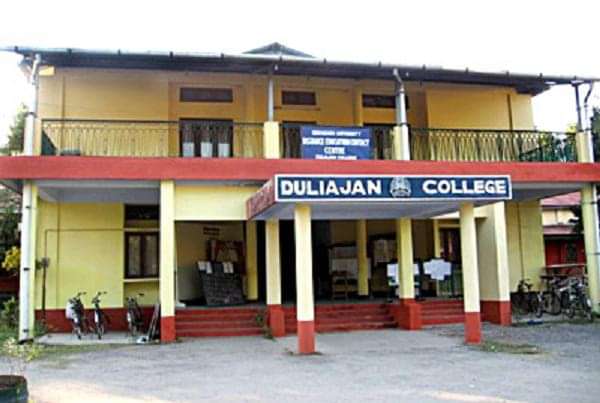
Duliajan Girls' College
About
OfficialDuliajan Girls' College is a other institution in Dibrugarh, established in 1969. Duliajan Girls' College is a premier women's education institution located in Duliajan, Dibrugarh district, Assam. Established in 1974, the college has evolved into one of Assam's most respected girls' colleges, offering comprehensive undergraduate and postgraduate programs across Sciences, Arts & Humanities, and Commerce. The college is affiliated with Dibrugarh University and serves approximately 1,850 female students across multiple disciplines. The institution's mission centers on empowering women through quality education, skill development, and fostering social consciousness. The college campus spans 8.5 acres in a peaceful suburban setting, providing a conducive environment for academic pursuits while maintaining proximity to Dibrugarh city's amenities. Duliajan Girls' College has established itself as a strong undergraduate institution with particular emphasis on Sciences education. The college offers Bachelor of Science (Hons.) programs in Physics, Chemistry, Botany, and Zoology, alongside Bachelor of Arts programs in English, Assamese, History, Political Science, and Economics. The Commerce department offers Bachelor of Commerce with specializations in Accountancy and Economics. All undergraduate programs are 3-year degree programs with annual intakes ranging from 40-60 students per stream. The college also offers 2-year Master's programs in Physics, Chemistry, and English, catering to students seeking advanced study. The infrastructure includes well-equipped laboratories for Physics and Chemistry experiments, a library housing over 15,000 books covering Science, Arts, and Commerce domains, and dedicated computer labs with internet connectivity. The Science laboratories have been recently upgraded with modern equipment for undergraduate experiments in optics, mechanics, thermodynamics, organic and inorganic chemistry, and botanical studies. The college library provides access to academic journals, reference books, and digital resources through UGC-funded digital library initiatives. Academic strengths lie particularly in the Sciences domain, where faculty members engage in teaching-focused research aligned with Dibrugarh University curricula. Chemistry and Physics faculty have published research papers in peer-reviewed journals, though research output remains primarily teaching-oriented rather than cutting-edge. The college does not have a dedicated research center but encourages faculty and senior undergraduate students to undertake small-scale research projects. Placement outcomes have gradually improved, with 2023-24 data showing approximately 62-68% placement rate among graduates, varying by stream. Science stream graduates typically secure placements in educational institutions, pharmaceutical companies, and civil service sectors. Commerce graduates are placed in banking, accounting, and business process outsourcing sectors. Arts graduates pursue teaching, civil services, and media-related roles. The median salary for placed graduates ranges between 240,000-320,000 INR annually, with higher-paying roles in banking and IT-enabled services. However, placement rates lag behind premier women's colleges in metro cities, reflecting the college's position as a strong regional institution rather than a pan-India placement hub. Campus life at Duliajan Girls' College reflects a supportive women-centric educational environment. The hostel accommodates approximately 400 students across three buildings with 2-3 students per room, providing a home-like atmosphere for out-of-state students. Hostel facilities include basic furnishings, shared bathrooms, a common study room, and indoor games. Monthly hostel fees are approximately 8,000-10,000 INR, inclusive of basic utilities. The mess provides vegetarian meals with a monthly cost of 5,500 INR for lunch and dinner. Students report the hostel environment as supportive and community-oriented, though amenities are functional rather than luxurious. The college has active clubs including the Science Club, English Literary Society, Economics Forum, Sports Club, Cultural Committee, and Social Service Club. Annual events include the college day (March), Science Fair (August), Sports Day (October), and Cultural Fest (January) featuring traditional and contemporary performances. Sports facilities include a volleyball court, badminton courts, indoor games room, and outdoor sports ground. However, dedicated sports infrastructure like an athletic track or swimming pool is absent, limiting opportunities for athletes preparing for competitive sports events. Internet connectivity covers the campus and hostel with approximately 5-8 Mbps speed, adequate for routine academic purposes but occasionally experiencing congestion during peak usage. Student safety is a notable strength, with no ragging incidents reported in recent years, strict anti-ragging policies enforced, and a functioning women's grievance cell. The overall student rating for campus life is approximately 7.2/10, with positive feedback on academic support and hostel community, but constructive criticism regarding limited extracurricular infrastructure and slow internet speeds. The college is particularly recommended for girls seeking quality undergraduate education in Sciences with a focus on board exam preparation and teacher-training pathways, students from Assam or Northeast India prioritizing a supportive all-women's environment, and aspirants planning postgraduate studies in Sciences. The college has produced several notable alumni in education, research, and civil services, reflecting its primary contribution to the teacher training and academic professional pipeline in Assam. However, it is not the optimal choice for students targeting placements in top technology companies, those seeking research-intensive programs, or students requiring metropolitan amenities and networks. The college's greatest strength is its nurturing, all-women's academic environment with experienced faculty, while its primary limitations are geographic location outside major metro centers, limited placement breadth beyond education and traditional sectors, and basic infrastructure compared to well-funded premier institutions.