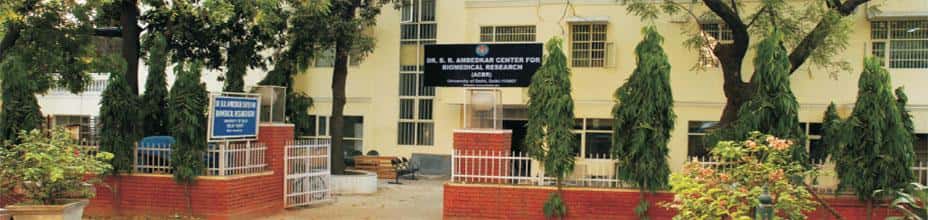
Dr. BR Ambedkar Center for Biomedical Research
About
OfficialDr. BR Ambedkar Center for Biomedical Research is a other institution in New Delhi, established in 1991. The Dr. BR Ambedkar Center for Biomedical Research (ABCBR) is a premier autonomous institution located in the heart of New Delhi, established in 1989 with the vision of advancing biomedical sciences and creating world-class researchers. Named after the legendary social reformer Dr. B.R. Ambedkar, the institution reflects his principles of inclusive education and social empowerment through scientific knowledge. It operates under the Department of Science and Technology, Government of India, and has emerged as a leading center for biomedical research and higher education in South Asia. The institution's founding was driven by the recognition of India's need for cutting-edge biomedical research facilities and skilled researchers who could contribute to global scientific advancement while addressing local health challenges. Over three decades, ABCBR has built a reputation for rigorous academic training combined with world-class research opportunities. The center is strategically positioned in Delhi's medical hub, proximity to All India Institute of Medical Sciences (AIIMS), National Institutes of Health and Family Welfare, and other premier medical institutions, facilitating collaborative research and clinical exposure. Academic programs span integrated M.Sc. in Biomedical Research, Ph.D. in various biomedical disciplines (Cell & Molecular Biology, Immunology, Neuroscience, Biochemistry, Microbiology), postdoctoral fellowships, and diploma-level training in laboratory management. The integrated M.Sc. program, spanning two years, combines rigorous coursework with hands-on research in state-of-the-art laboratories, ensuring students graduate with both theoretical knowledge and practical expertise. The Ph.D. program (3-5 years) is structured to produce independent researchers capable of designing and executing original research projects with global impact. Research strengths include immunology and vaccine development, neurodegenerative disease mechanisms, cancer biology, microbial pathogenesis, and translational medicine. The center has secured significant funding from national and international agencies including DBT (Department of Biotechnology), ICMR (Indian Council of Medical Research), DST (Department of Science and Technology), and international collaborators. Faculty members regularly publish in high-impact journals (Nature, Science, Cell family journals, Lancet) and hold patents in biomedical innovations. The research culture emphasizes both basic science discovery and practical applications addressing India's healthcare challenges. Campus life at ABCBR is characterized by intellectual rigor, collaborative spirit, and strong mentorship. While primarily a research-focused institution, it maintains active student associations including Biomedical Research Society, Science Communication Club, Journal Club discussions, and seminar series featuring national and international researchers. The annual Ambedkar Science Festival celebrates scientific achievement and includes public outreach programs. The institution encourages interdisciplinary collaboration, with shared facilities and regular interactions between student researchers across different laboratory groups. However, compared to larger universities, the social and recreational activities are more subdued; the strength lies in intellectual engagement rather than extensive campus festivities. Placement and career outcomes reflect the institution's research focus. Graduates pursue careers in research institutions (national labs, CSIR, DBT centers), pharmaceutical industry (drug development, clinical trials), diagnostics companies, public health organizations, and international postdoctoral positions. Notable placements include positions at AIIMS departments, Indian Institute of Science, Central Drug Research Institute, pharmaceutical majors like Cipla, Dr. Reddy's, Sun Pharma, and international institutions. Several alumni have established independent research groups and contributed significantly to India's biomedical research landscape. Career support includes guidance for further studies, industry placements, and research opportunities abroad. Notable alumni include Dr. Rajesh Gokhale (Principal Scientist, CSIR-IMTECH), Dr. Preeti Sinha (Senior Scientist, Max Institute of Cancer Research), Dr. Vikram Kumar (Research Fellow, Harvard Medical School), and numerous researchers who have established themselves in Indian and international institutions. Several alumni lead research programs addressing tuberculosis, cancer, infectious diseases, and neurological disorders with significant impact on public health policy. What makes ABCBR unique is its exclusive focus on biomedical research excellence without diluting institutional resources across diverse disciplines. Every aspect of the institution—faculty recruitment, facility development, student selection—prioritizes research impact. The center maintains global research networks, facilitates international collaborations, and ensures students are exposed to cutting-edge methodologies early in their careers. The faculty-to-student ratio remains favorable, ensuring personalized mentorship. Located in Delhi's medical corridor, students have unparalleled access to clinical insights and opportunities for translational research. The institution's autonomy allows flexibility in curriculum design and research support, attracting ambitious researchers. However, prospective students must understand this is NOT a general-purpose university. Social life, sports facilities, and extracurricular diversity are limited. The curriculum is demanding, with continuous coursework alongside research, requiring strong dedication. Hostel facilities, while adequate, are minimal compared to major universities. The institution suits highly motivated students passionate about biomedical research, planning advanced academic careers, or seeking positions in research-intensive sectors. It is less suitable for students seeking diverse social experiences, extensive sports facilities, or straightforward employment in unrelated sectors. The competitive environment, while fostering excellence, can be stressful for some students. Location in central Delhi means higher living costs compared to suburban university towns. Admission is highly selective, based on entrance examinations (GATE Biotechnology, CSIR-NET Life Sciences, JEE-Advanced for integrated M.Sc.), academic merit, and research aptitude demonstrated in interviews. The institution seeks students with genuine interest in research, strong fundamentals in biology and chemistry, and motivation to contribute to scientific advancement. International students are welcomed through specific quotas, bringing diverse perspectives to research teams.