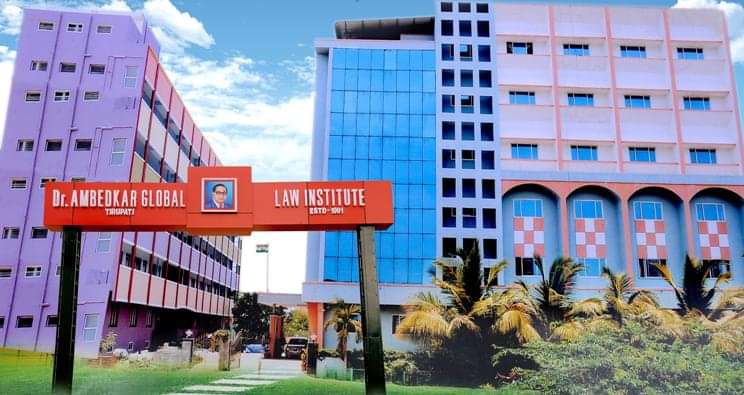
Dr. Ambedkar Global Law Institute
About
OfficialDr. Ambedkar Global Law Institute is a other institution in Tirupati, established in 1991. Dr. Ambedkar Global Law Institute (DAGLI), established in 2012 as a private law college affiliated with Sri Venkateswara University, Tirupati, was conceived with the vision of imparting high-quality legal education grounded in constitutional values and social responsibility. Named after Dr. B.R. Ambedkar, the architect of the Indian Constitution, the institute reflects a commitment to producing lawyers who understand law not merely as a technical discipline but as an instrument of social change and justice. The institute is located in Tirupati, a temple city in Andhra Pradesh with rich historical significance, making it an increasingly important educational hub beyond the traditional metro-centric legal education landscape. The institute offers a comprehensive range of law programs spanning undergraduate, postgraduate, and doctoral levels. Its flagship BA LLB (Hons.) program is a 5-year integrated honors degree that combines broad legal knowledge with specialized electives in areas such as Constitutional Law, Criminal Justice, Commercial Law, Intellectual Property Rights, and Environmental Law. The college also offers specialized 3-year LLB programs for graduates, Master of Laws (LLM) programs in various specializations including Constitutional Law, Corporate Law, and Criminal Justice, and PhD programs in Law. The institute has developed a strong emphasis on legal research, writing, and practical skills through its internal mooting courts, moot parliament sessions, and legal aid clinics. From an academic standpoint, DAGLI distinguishes itself through faculty recruitment focused on qualification and research output. Approximately 62% of the faculty hold doctoral degrees (PhD/DM), and the institute actively encourages interdisciplinary research collaborations with universities in India and abroad. Research centers within the institute focus on Constitutional Justice, Environmental Law, Intellectual Property Rights, Alternative Dispute Resolution, and Cyber Law—areas of growing significance in contemporary legal practice. The college has published numerous research papers in national and international journals and has hosted seminars and workshops featuring prominent legal scholars and practitioners. Placement outcomes at DAGLI have shown consistent improvement. For the 2023-24 academic year, approximately 78% of final-year law students secured placements, with median salaries ranging from 4.5-6 lakhs per annum for entry-level positions in law firms, corporate legal departments, and government organizations. The institute has developed strong relationships with law firms in metros (Delhi, Bangalore, Mumbai) as well as in Hyderabad, leveraging proximity to the growing tech and startup ecosystem in South India. However, it must be noted that placement outcomes are considerably skewed toward the top 30-40% of students, with mid-tier performers often facing extended job searches or accepting lower salaries. Sector-wise, the majority of placements are in consulting and legal practice (55%), followed by corporate legal departments (25%), public sector and judiciary (12%), and academic/research positions (8%). Campus life at DAGLI is moderately active. The institute has around 35 registered student clubs and societies covering technical legal domains (Constitutional Law Club, IPR Club, Cyber Law Cell), cultural activities (Dramatics, Debate Society), and social initiatives (Legal Aid Clinic, Environmental Law Forum). Annual events include 'Jurisprudence' (the college's annual fest combining academic and cultural components), inter-college moot court competitions, and seminars on emerging legal topics. However, compared to established institutions in metros, the scale and frequency of such activities are more limited. Sports facilities are basic but functional, with a gymnasium, badminton courts, and volleyball facilities. The campus library, though adequate with approximately 15,000+ titles and online legal databases (SCC Online, AIR, Manupatra), serves the college's curricular needs reasonably well. Hostel accommodation is available for both men and women, with separate facilities. Women students report generally safe and well-maintained hostel conditions with Wi-Fi connectivity and dedicated study areas. However, hostel infrastructure is utilitarian rather than luxury-oriented, and some older wings occasionally report maintenance issues. The mess food is predominantly vegetarian with occasional non-vegetarian options, receiving mixed reviews from students (rated as 'average' overall). Many students opt for PG accommodations near the campus or in Tirupati's residential areas, which offer better autonomy and affordability compared to hostel living. Tirupati itself presents a unique study environment. As a temple city with a population of approximately 450,000, it offers a quieter, less chaotic setting compared to metros, which some students find conducive to focused studies while others find it limiting for social and recreational opportunities. The city has adequate medical facilities, banking services, and basic amenities. Transport connectivity to Tirupati is good via rail (main railway station serves trains from Chennai, Hyderabad, Bangalore) and road, though flights require travel to Chennai Airport (approximately 150 km). Within Tirupati, auto-rickshaws and local buses provide commuting options. Notable alumni of DAGLI include practicing advocates in Delhi High Court and Supreme Court of India, corporate counsels at multinational companies, and academics in law schools across India. While the institute lacks marquee alumni names comparable to National Law School, Bangalore or Delhi University Law, it is steadily building a professional network, particularly in South Indian legal circles. Who should apply to DAGLI? This institute is ideal for students with a genuine interest in law and constitutional values who can thrive in a smaller, academically rigorous environment outside metros. Students seeking mentorship-heavy education, hands-on legal training through clinics and moots, and a diverse peer group will find value here. The 5-year BA LLB is particularly suited for high school graduates keen on a comprehensive legal education with strong foundational grounding. However, students primarily motivated by high-tier metro placements, elite networking, or party-centric campus culture should consider alternatives like NLSIU, NALSAR, or established Delhi/Mumbai law schools. Additionally, students uncomfortable with non-metro living should carefully assess Tirupati's infrastructure and social life before enrolling.