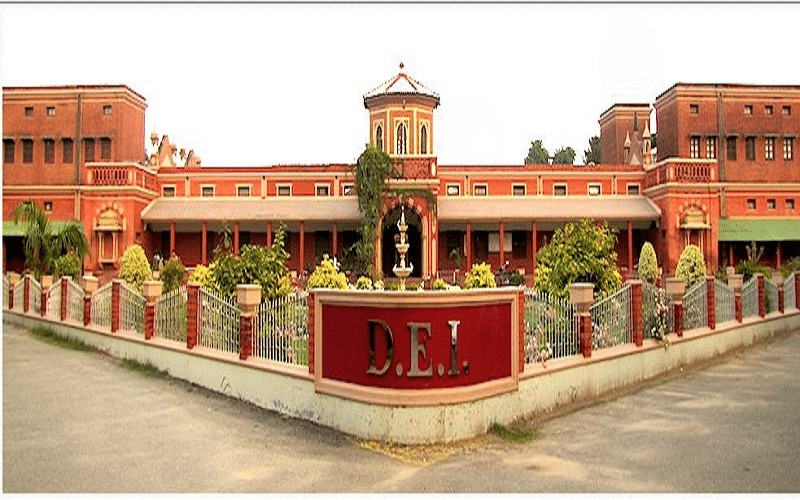
Dayalbagh Educational Institute Faculty of Engineering, Agra
About
OfficialDayalbagh Educational Institute Faculty of Engineering, Agra is a other institution in Agra, established in 1950. Dayalbagh Educational Institute (DEI) was established in 1915 as part of the Radhasoami Satsang movement's vision for holistic education. Located in Agra, Uttar Pradesh, the Faculty of Engineering is one of India's oldest private engineering institutions, predating many NITs and IITs. The institute operates under a unique religious-philosophical framework emphasizing spiritual development alongside technical excellence, which creates a distinctive campus culture that attracts students seeking alternative educational paradigms. DEI's engineering faculty offers undergraduate and postgraduate programs in Civil, Mechanical, Electrical, Electronics & Communication, Computer Science, and emerging disciplines like Data Science and Artificial Intelligence. The institute has consistently maintained academic rigor with a strong emphasis on practical training, research, and industry collaboration. The campus, spread across 150 acres in suburban Agra, provides a serene learning environment away from urban chaos, though this isolation presents both advantages (fewer distractions, strong community bonding) and disadvantages (limited city amenities, connectivity challenges). The student body is relatively small and diverse, with students arriving from across India seeking a balanced approach to engineering education. DEI's placement record has improved substantially over the past five years, with major recruiters from software, analytics, and manufacturing sectors visiting regularly. However, placements are still not at the level of top IITs or NITs. The institute maintains strong ties with Radhasoami philosophy, which permeates campus life through weekly spiritual sessions, dietary restrictions (predominantly vegetarian), and emphasis on ethical conduct. This appeals strongly to spiritually-inclined students but may feel restrictive or limiting to others. The faculty comprises a mix of Ph.D. holders and industry professionals, with increasing focus on research publications and industry partnerships. Infrastructure has undergone modernization in recent years with new computing labs, research facilities, and improved hostels. The institute is NAAC accredited (currently seeking Grade A re-accreditation) and has NBA accreditation for several engineering programs. Research activities focus on renewable energy, water resource management, materials science, and sustainable development—aligned with the institute's philosophical commitment to societal welfare. DEI is particularly strong for students interested in civil and mechanical engineering with emphasis on sustainable infrastructure. It remains a hidden gem for candidates seeking quality engineering education outside the mainstream IIT-NIT-BITS circuit, especially those valuing holistic development, ethical education, and community living. However, prospective students must be aware that career outcomes, particularly in high-paying sectors like finance and premium tech roles, may not match elite institutions. The institute works best for self-motivated students comfortable with its spiritual environment and ready to leverage strong academics and practical skills for career building. Notable alumni include engineers in public sector undertakings, private industry leaders, and academics, though the institute lacks the celebrity alumni presence of IITs. Admission is merit-based through JEE Main (for B.Tech) and entrance examinations for postgraduate programs. The institute attracts serious engineering candidates who may have narrowly missed IIT cutoffs or specifically seek DEI's educational philosophy.