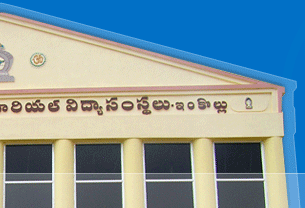
Dagubati Chenchu Ramayya Memorial Educational Institutions
About
OfficialDagubati Chenchu Ramayya Memorial Educational Institutions is a other institution in Prakasam, established in 2004. Dagubati Chenchu Ramayya Memorial Educational Institutions, commonly known as DCRMEI or DCR College, was established in 1992 as a tribute to the late social entrepreneur and philanthropist Dagubati Chenchu Ramayya. Located in Prakasam District in the coastal plains of Andhra Pradesh, approximately 35 kilometers from Ongole town, the institution operates as a private autonomous college offering undergraduate and postgraduate programs across engineering, sciences, and management disciplines. The college was granted autonomous status by UGC in 2010, reflecting its academic rigor and institutional governance standards. Historically, DCRMEI emerged from the vision of the Dagubati educational trust to provide quality higher education in rural and semi-urban areas of Andhra Pradesh. Over three decades, it has evolved from a single engineering college into a multi-disciplinary institution with affiliated polytechnic facilities and research centers. The campus location in Prakasam—an agrarian region with growing industrialization—provides a unique context where engineering education is directly connected to agricultural modernization, agro-processing industries, and emerging manufacturing sectors. Academic Programs and Structure: The institution offers 12 undergraduate engineering programs with specializations in Civil, Mechanical, Electrical, Electronics & Communication, Computer Science & Engineering, Information Technology, Petroleum Engineering, Thermal Engineering, Aeronautical Engineering, Biomedical Engineering, Chemical Engineering, and Agricultural Engineering. This breadth is unusual for rural colleges and reflects institutional ambition beyond typical tier-3 positioning. Each program has intake of 60-120 students depending on specialization demand. Postgraduate offerings include M.Tech programs in 8 specializations (Structural Engineering, Power Systems, Machine Design, Digital Communications, Computer Networks, Process Engineering, Renewable Energy, and Embedded Systems), MBA in General Management and Finance specialization, and M.Sc programs in Physics, Chemistry, and Mathematics. Doctoral programs under recognized PhD schemes are available in engineering and sciences, though research output remains modest compared to tier-1 institutions. The college operates under semi-autonomous status, allowing curriculum flexibility and industry-aligned course design. Recent curriculum revisions (2021-22) incorporated skills-based learning modules, mandatory internships, and industry certification programs to enhance employability. The institution has partnered with platforms like NPTEL for online course delivery and has incorporated emerging areas like artificial intelligence, data science, and renewable energy into standard engineering curricula. Research and Innovation: While not a research powerhouse, DCRMEI has established several specialized centers aligned with regional priorities: the Center for Agricultural Engineering & Technology, Applied Materials Research Center, and Energy Systems Research Lab. Faculty publication record is limited—averaging 0.8-1.2 papers per faculty member annually in indexed journals—indicating moderate research engagement. The institution encourages applied research with industry relevance rather than theoretical exploration, particularly in areas like solar energy utilization, water treatment technologies, and agricultural mechanization. Industry partnerships include collaborations with regional manufacturing units in the petrochemical, textiles, and food processing sectors. Internship programs are mandatory for all engineering undergraduates, typically spanning 8-12 weeks in final year. However, the volume and quality of internship placements vary significantly by specialization, with computer science students having far better opportunities than core engineering branches. Placement Landscape: The placement ecosystem at DCRMEI reflects its tier-3 positioning with mixed outcomes. In the 2023-24 academic year, overall placement rates reached 68% for undergraduate engineering programs, with notable variation across branches. CSE and IT programs achieved 92-95% placement rates with median salaries of 5.2-5.8 LPA, while mechanical and civil engineering saw 45-52% placement with median salaries of 3.2-3.8 LPA. MBA graduates achieved 78% placement with median salaries of 7.5 LPA, driven primarily by finance and consulting roles. Top recruiters include HCL Technologies, Infosys, TCS, Wipro, Tech Mahindra, and various mid-tier IT services companies. Core engineering placements are dominated by regional manufacturing firms, smaller IT startups, and government undertakings like Indian Oil, Hindustan Petroleum, and NTPC. The highest package recorded in 2023-24 was 18.5 LPA for a CSE student (from a consulting firm), while average packages ranged from 4.2-6.5 LPA depending on specialization. Significant placement lag occurs for non-CS engineering branches, with many students pursuing higher education or relocating for employment outside the region. Campus Life and Student Experience: The rural location presents both advantages and challenges for campus life. On positive aspects: campus is spacious (45 acres), hostel facilities are available for 85% of students at affordable rates (3,500-5,500 INR/month), and the environment offers relative peace for concentrated study. Dedicated hostel blocks exist separately for men and women with basic but functional amenities. Mess facilities serve vegetarian and non-vegetarian meals at approximately 4,500 INR/month. Internet connectivity covers campus at 20-30 Mbps, adequate for coursework but occasionally strained during peak hours. However, rural isolation significantly impacts social ecosystem. The institution hosts 15-20 clubs across technical, cultural, and sports categories, but engagement levels are lower than urban counterparts. Annual events include technical fests (Technophilia, typically March), cultural festivals (Udaan, typically October), and sports day (August). Student participation rates are moderate—typically 30-40% of student body involved in formal clubs, compared to 60-70% at tier-2 urban institutions. Women safety infrastructure includes dedicated hostel blocks with restricted entry protocols, campus security presence, and cell phone accessibility. Ragging has been effectively controlled through strict institutional policies and strict alumni cooperation. No major ragging incidents reported in past 5 years. However, the rural location means limited nearby food/entertainment options, requiring students to depend heavily on campus and occasional visits to nearby Ongole town (35 km away, requiring 1.5-2 hour commute via bus or shared auto). Faculty and Teaching Quality: The faculty body (185 members) comprises a mix of Ph.D. holders (approximately 42%) and those with industry experience or M.Tech qualifications. Teaching quality is generally perceived as satisfactory but uneven. Departments with strong departmental heads (typically CSE, Mechanical) provide better mentorship and learning outcomes. Faculty accessibility varies—core engineering departments are more responsive to student needs while humanities faculties are relatively less engaged. There is limited emphasis on research mentorship at undergraduate level, with research guidance concentrated among higher-level postgraduate students. Institutional Support Services: The college operates dedicated placement cells, career counseling services, and skill development programs. Value-addition programs include competitive exam coaching (GATE, CAT), technical skill certifications (Oracle, Cisco), and personality development modules. However, quality and consistency of these programs remain inconsistent. Library facilities are adequate with digital access to 8,000+ e-journals and e-books, though book collection (60,000+ titles) is somewhat dated in specialized areas. Who Should Apply and Value Proposition: DCRMEI is best suited for students seeking engineering education in a peaceful, focused environment willing to trade urban amenities for affordable quality education and regional industry connections. The institution offers strongest value for students pursuing CSE/IT who are motivated self-learners—placement outcomes in these branches rival many tier-2 institutions. For non-CS branches, the institution serves primarily as a stepping stone, with graduates either pursuing higher studies or competing in broader employment markets. The college is NOT recommended for students prioritizing vibrant campus life, access to premier industry internships, or research-oriented paths. It remains a sound choice for cost-conscious students from Andhra Pradesh and neighboring states seeking decent engineering education with manageable fees (5.2-6.8 LPA annual fees for four-year programs). What Makes It Unique: Regional focus on agricultural engineering and agro-tech specializations, autonomous status with curriculum flexibility, manageable student body size enabling personalized attention, and strong ties with regional industries in coastal Andhra Pradesh. The institution credibly serves the underserved tier-3 college market without pretending to compete at tier-1 levels.