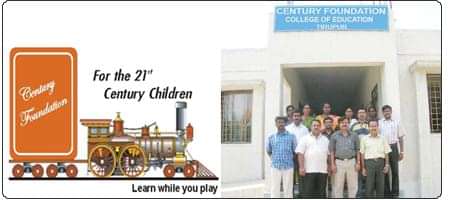
Century Foundation College of Education
About
OfficialCentury Foundation College of Education is a other institution in Tiruppur, established in 2007. Century Foundation College of Education, established in 1995 in Tiruppur, Tamil Nadu, is a private institution that has evolved from a modest teacher training college into a multi-disciplinary educational hub. Located on the outskirts of Tiruppur on the NH 209 corridor, the college sits in a suburban setting approximately 8 km from the city center, providing a balance between academic tranquility and urban accessibility. The institution was founded with a mission to democratize quality education and create professionally competent educators and managers for the evolving knowledge economy. Over nearly three decades, it has established itself as a regional player in teacher education, nursing, and increasingly in commerce and management studies. The college operates under the governance of Century Foundation Trust, a non-profit educational organization with interests in multiple educational verticals across Tamil Nadu. Administratively, the college is affiliated with Tamil Nadu Open University (TNOU) for distance education programs and maintains academic partnerships with Bharathiar University for undergraduate programs and Alagappa University for postgraduate studies. The campus infrastructure has undergone significant modernization in the past 5-7 years, with the addition of a new academic block, upgraded laboratory facilities, and enhanced digital learning infrastructure. The college's academic philosophy emphasizes practical pedagogy, community engagement, and alignment with contemporary employment needs. Academic programs span education (BA.B.Ed, M.Ed), nursing (BSc Nursing), commerce (B.Com, M.Com), and management (MBA in Education Management). The teacher education program remains the institutional flagship, with 450+ student teachers graduating annually across various specializations. The nursing program, launched in 2008, has gained recognition for producing healthcare professionals suited to rural and semi-urban settings. Research at Century Foundation is predominantly applied in nature, focusing on pedagogical innovation, teacher effectiveness studies, and rural healthcare delivery. Faculty research output, while modest compared to autonomous institutions, shows steady growth with approximately 40-50 papers published annually in national and regional journals. The college has established MoUs with 12+ organizations including NGOs focused on rural education and healthcare, facilitating internship and research collaboration opportunities. Campus life reflects a mixed student demographic—a significant portion are working professionals pursuing distance education or evening programs, while full-time residential students constitute about 35% of the total enrollment. This diversity creates a more mature, professionally-oriented campus culture compared to traditional undergraduate-dominated institutions. The residential hostel accommodates approximately 280 students, with separate facilities for men (180 capacity) and women (100 capacity). Sports and cultural activities are organized regularly, though not at the scale of larger institutions. The placement ecosystem is functional but not exceptional; placement drives are conducted twice yearly with participation from schools, education startups, hospitals, and smaller corporate entities. The median placement rate across undergraduate programs is approximately 72%, with M.Ed graduates showing stronger placement percentages (85-90%) due to school hiring cycles. Notable alumni include education administrators, school principals, nursing educators, and corporate trainers spread across Tamil Nadu, Karnataka, and Andhra Pradesh. The college attracts students primarily from Tamil Nadu and neighboring states, with a strong base from semi-urban and rural backgrounds seeking teacher training or healthcare education at affordable costs. Infrastructure limitations include a relatively smaller library (18,000 volumes) compared to larger institutions, and research facilities that are functional but basic. The college is most suitable for students aspiring toward teaching professions, nursing careers, or educational management who prioritize affordability, practical training, and placement support over prestige or research opportunities. It serves as an effective stepping stone for candidates from non-metropolitan backgrounds seeking stable, mission-driven career paths in education and healthcare sectors.