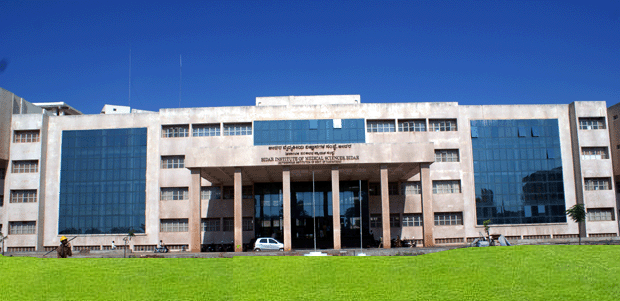
Bidar Institute of Medical Sciences
About
OfficialBidar Institute of Medical Sciences is a other institution in Bidar, established in 2005. Bidar Institute of Medical Sciences (BIMS) was established in 2010 as a private medical institution in Karnataka with a focus on providing quality medical education and healthcare services to the region. Located in Bidar, a historically significant city in North Karnataka, BIMS has grown to become a recognized center for medical education, though it operates in a relatively underdeveloped educational ecosystem compared to premier medical colleges. The institute is affiliated with Rajiv Gandhi University of Health Sciences (RGUHS), Bangalore, ensuring curriculum standardization across Karnataka's medical colleges. The institution offers undergraduate and postgraduate programs in medicine, nursing, and paramedical sciences, with a total student population of approximately 850 students across all programs. BIMS follows the standard MBBS curriculum as prescribed by the Medical Council of India (now National Medical Commission), focusing on a blend of theoretical knowledge and clinical exposure. The undergraduate MBBS program spans 4.5 years including internship, with an annual intake of 100 students through the NEET examination. Postgraduate programs include MD and MS specializations in various disciplines including Internal Medicine, Pediatrics, Obstetrics & Gynecology, Surgery, and others, with selective intake based on NEET-PG performance. The nursing program operates at both Bachelor (B.Sc. Nursing) and diploma levels, serving as a crucial pipeline for healthcare professionals in the region. The institution is recognized by the Indian Nursing Council and runs strong nursing programs with significant employment opportunities post-graduation. The paramedical sciences programs include laboratory technology, radiography, and operation theater technology, offering diverse career pathways in healthcare. The college maintains a teaching hospital with approximately 400 beds that serves as a primary training ground for students, providing exposure to diverse patient populations and clinical scenarios. The hospital functions as a tertiary care center managing complex cases, allowing students substantial hands-on experience in emergency medicine, trauma management, and specialized care. Research activities at BIMS focus on epidemiological studies relevant to the North Karnataka region, including work on communicable and non-communicable diseases prevalent in semi-urban and rural populations. Faculty members have published papers in national journals, though the research output remains modest compared to established medical colleges. The institute has established collaborations with healthcare organizations for clinical training and placement purposes. Campus life at BIMS reflects the semi-urban character of Bidar, with students enjoying a relatively close-knit community though fewer entertainment and commercial amenities compared to metropolitan locations. The college has adequate hostel facilities for both men and women students, essential given that many students come from distant parts of India. The institutional culture emphasizes professional ethics, patient care orientation, and community health awareness, with regular community health camps and awareness programs conducted in surrounding villages. The placement record for MBBS graduates shows consistent employment in government and private healthcare setups, with many pursuing postgraduate studies or establishing medical practices. PG graduates typically secure positions in tertiary care hospitals, academia, or private practice across India. However, placement statistics are less comprehensive compared to premier medical institutions, and salary structures vary significantly based on specialization and individual negotiation. Notable alumni include several practitioners who have established successful medical practices in North India and professionals working in healthcare administration and public health. The college has produced academicians who serve in faculty positions at other medical institutions. Notable alumni also include healthcare administrators and public health professionals contributing to healthcare delivery systems across India. BIMS is particularly suited for students aspiring to practice medicine in semi-urban and rural settings, those interested in community health and primary healthcare, and students from North India seeking quality medical education at more accessible locations. The institution serves as a gateway for NEET-qualified candidates who may not secure seats in highly competitive government medical colleges but seek comprehensive medical training. The college is also ideal for nursing aspirants seeking structured training with good clinical exposure and employment prospects. Students should be aware that Bidar lacks the cosmopolitan amenities of metro cities, research output is below elite institutions, and placement statistics show lower salaries compared to top-tier medical colleges. However, the personal attention, clinical exposure, and community-oriented education make it a reasonable choice for committed medical students. The institution's strength lies in its regional relevance, affordable fees compared to major private medical colleges in metros, and genuine focus on practical clinical training rather than merely theoretical excellence. The college has been gradually improving infrastructure and faculty qualifications, with recent additions to diagnostic facilities and establishment of modern operation theaters. Student life benefits from the peaceful academic environment, though students from metro backgrounds may find the city restrictive. The cost of living in Bidar is significantly lower than metros, making overall medical education more affordable. The institution is working toward improving research metrics and international collaborations to enhance its academic reputation. For students prioritizing affordability, clinical exposure, and community health orientation over brand name and research rankings, BIMS represents a viable option in the Indian medical education landscape.