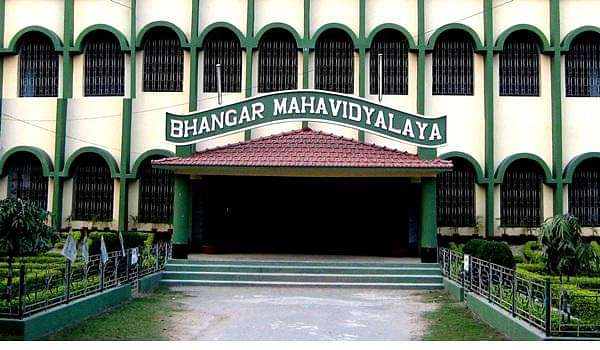
Bhangar Mahavidyalaya
About
OfficialBhangar Mahavidyalaya is a other institution in 24Pgns(S), established in 2005. Bhangar Mahavidyalaya, established in 1984, is a government-aided general college located in the Bhangar block of South 24 Parganas district in West Bengal. The college serves as a primary higher-education hub for students from rural and semi-urban backgrounds across South Bengal. Founded with the mission to provide affordable, quality education to underserved communities, it has evolved into a multi-faculty institution offering undergraduate and postgraduate programs across sciences, humanities, and commerce. The college operates under the affiliation of Calcutta University and follows the curriculum prescribed by the university. Its academic strength lies in foundational science and arts education, with particular emphasis on developing critical thinking and research aptitude among students from economically weaker sections. The institution has gradually expanded its course offerings to include skill-based programs aligned with employability needs. Academic Programs: The college offers undergraduate (BA, B.Sc, B.Com) and postgraduate (M.A, M.Sc) programs. Science programs include Physics, Chemistry, Biology, and Mathematics combinations. Humanities stream covers Bengali, English, History, Political Science, Philosophy, and Sociology. Commerce stream provides accounting, economics, and business studies focus. The institution has introduced vocational and skill development programs in partnership with government schemes. Research and Innovation: While not a research-intensive institution, the college encourages faculty research within resource constraints. Several faculty members are engaged in environmental studies, agricultural science applications, and social sciences research. The college has established a modest research cell and encourages publication in academic journals. However, research infrastructure remains limited compared to urban colleges. Campus and Infrastructure: The campus spans 18 acres with adequate green spaces, reflecting its semi-rural setting. Buildings include academic blocks for science, arts, and commerce faculties, administrative offices, library, and sports grounds. Infrastructure reflects government college standards—functional but not state-of-the-art. The library houses approximately 12,000 volumes with limited digital resources. Internet connectivity is inconsistent in parts of campus. Laboratory facilities for physics, chemistry, and biology are basic but functional for undergraduate teaching. The college has been receiving gradual infrastructure upgrades through government grants. Placement and Career Outcomes: The college's placement record is modest, typical of rural government colleges. Many graduates pursue further education through postgraduate programs or competitive exams (UPSC, WBPSC, SSC). Direct campus placements are limited to 15-25% across programs, primarily through mass recruitment drives in teaching, banking (clerk positions), and insurance sectors. Students from science streams have better placement prospects. The college recently established a placement cell with dedicated staffing. Career counseling is emerging but not yet comprehensive. StudentCulture and Campus Life: The college hosts an active student community with cultural programs, sports competitions, and academic seminars. The annual college fest 'Bhangar Utsav' showcases cultural talent and includes technical symposiums. Student unions actively organize debates, quiz competitions, and cultural events. Sports infrastructure supports cricket, football, volleyball, and athletics. However, campus life is less vibrant compared to urban colleges due to limited recreational infrastructure and the rural setting. Who Should Apply: Bhangar Mahavidyalaya is ideal for students from rural West Bengal, particularly those who cannot afford expensive private institutions or don't secure seats in Kolkata-based government colleges. It suits students prioritizing affordable, quality education with a supportive learning environment. Strong candidates are science students aspiring for postgraduate studies or UPSC preparation, and commerce/arts students seeking foundational education before competitive exams. The college is less suitable for students seeking world-class research infrastructure, vibrant urban campus life, or high placement rates in multinational companies. Students should have realistic expectations about infrastructure limitations and understand that success here depends heavily on self-directed learning and exam preparation discipline. The rural location is suitable for focused, academically-inclined students but may feel isolating for those seeking cosmopolitan campus experience. The institution serves a crucial role in democratizing access to higher education but requires students with intrinsic motivation and ability to supplement college resources through independent study.