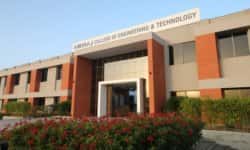
Amiraj College of Engineering and Technology
About
OfficialAmiraj College of Engineering and Technology is a other institution in Ahmedabad, established in 2012. Amiraj College of Engineering and Technology, established in 2007, is a private engineering institution located in Vallabh Vidyanagar, a suburb of Ahmedabad in Gujarat. The college was founded with the vision of providing quality engineering education blended with practical industry experience and strong ethical values. It operates under the Sardar Patel University academic framework, maintaining curriculum alignment with AICTE standards while fostering innovation-driven learning methodologies. The campus, sprawled over 45 acres in the outskirts of Ahmedabad near the Vadodara Expressway, is designed to balance academic rigor with modern amenities, though its remote suburban location necessitates careful consideration for daily commuting or hostel living. The institution offers undergraduate and postgraduate programs across 8 engineering disciplines with a total student body of approximately 2,400 students and a faculty strength of around 185. Academically, Amiraj positions itself as a progressive engineering college that emphasizes industry collaborations, internship programs, and skill development alongside traditional coursework. The college has established connections with over 200 companies for placements and internships, spanning IT, manufacturing, automotive, energy, and infrastructure sectors. Notable recruiter relationships include TCS, HCL, Infosys, KPMG, Mahindra & Mahindra, Bajaj Auto, and various tier-2 IT companies. The placement statistics for 2023-24 indicate an overall placement percentage of approximately 78%, with average salary packages around 4.8 LPA and median packages near 4.2 LPA. While these figures are respectable for a private engineering college, they remain noticeably lower than premier institutions like IITs and top-tier NITs. The highest package placement in recent years has been approximately 18 LPA, primarily in data science and software development roles. Research and innovation are encouraged through dedicated labs, final-year projects, and industry mentorship programs. The college hosts an innovation lab and has partnerships with academic institutions and research organizations, though its research output remains modest compared to older, better-funded institutions. Campus infrastructure includes a 2,00,000+ sq ft library with digital resources, engineering labs equipped with modern equipment, a computer center with high-end workstations, and sports facilities including cricket pitch, basketball court, volleyball court, and gymnasium. Hostel accommodation is available for approximately 800 students across separate blocks for male and female students. The hostel facilities are described as adequate but spartan, with shared rooms, basic furnishings, and common areas. Mess facilities provide vegetarian and non-vegetarian options, with quality varying seasonally. Internet connectivity across campus is generally satisfactory at 10-15 Mbps. The student body comprises primarily students from Gujarat and neighboring states, with a growing proportion from across India following improved JEE Main outreach. The college encourages student engagement through approximately 35+ clubs and societies covering technical, cultural, entrepreneurial, and sports categories. Annual events include Amirajfest (cultural event in October), Technofest (technical event in November), and sports day in January. However, student feedback indicates moderate enthusiasm for festival organization and execution. Student sentiment regarding Amiraj is mixed. Strengths include dedicated faculty in core engineering departments, genuine industry interface for placements, reasonable infrastructure for a private college, and a relatively harassment-free campus environment. Significant concerns include the distant suburban location creating commuting challenges (15-20 km from central Ahmedabad), limited walkable amenities around campus, high dependency on personal vehicles or long college shuttle rides, modest research opportunities compared to aspirations, and variable teaching quality across departments. The college is most suitable for: (1) Students from Gujarat and neighboring states seeking affordable private engineering education with reasonable placement prospects, (2) Candidates narrowly missing NIT cutoffs but capable of paying private college fees, (3) Students prioritizing specific engineering specializations offered here, (4) Those comfortable with hostel living and semi-campus settings. It is less suitable for: (1) Students expecting placement outcomes comparable to IITs/top NITs, (2) Those prioritizing cosmopolitan campus life and vibrant city integration, (3) Candidates with limited budget (fees at 3.5-4.2 LPA annually plus living costs), (4) Those seeking heavy research involvement. The college's unique positioning lies in its emphasis on "skill-based engineering," continuous industry partnerships, and competitive fee structure relative to similar private institutions in Gujarat. Notable alumni include professionals in IT leadership roles, manufacturing sector engineers, and startup founders, though the college lacks internationally recognized prominent alumni due to its relatively recent establishment and tier-2 placement positioning. Admission to undergraduate programs is merit-based through JEE Main All India Ranking (AIR), with cutoff ranks typically ranging from 55,000 to 1,20,000 depending on specialization and category. Postgraduate programs in Engineering (M.Tech) are admission through GATE scores and merit. The college accepts approximately 600-650 undergraduate students annually across all engineering programs. Academic year 2024-25 onward, the college has increased intake in Computer Science and Artificial Intelligence/Machine Learning branches in response to market demand, while intake in civil and mechanical engineering remains relatively stable. Fee structure for undergraduate engineering programs is approximately 3.5-3.8 LPA for the 4-year B.Tech degree, with additional development charges and examination fees. Hostel fees range from 65,000 to 85,000 INR per academic year. The total cost of engineering education at Amiraj, including hostel, mess, and personal expenses, typically ranges from 8.5 to 10.5 LPA over four years for students living on campus, and 7.5 to 9 LPA for daily commuters. This makes it moderately expensive compared to government engineering colleges but significantly cheaper than many urban private engineering institutions in India. The college maintains NAAC accreditation (Grade B level last evaluation) and has subject-wise NBA accreditation for select engineering programs including Computer Science, Electronics & Communication, and Mechanical Engineering. These accreditations validate curriculum standards and program quality, though Grade B NAAC indicates room for improvement in academic and administrative processes. Placements in the Engineering (Electronics & Communication) and Information Technology branches are strongest, with placement percentages above 85% and average packages around 5.5 LPA. Civil Engineering and Mechanical Engineering placements are comparatively weaker, with placement percentages around 65-70% and average packages near 3.8-4.2 LPA. The college operates with a mixed culture—while it maintains discipline and academic seriousness, the relatively younger student community and suburban isolation sometimes create a disconnected feel compared to urban college campuses. Faculty mentoring varies across departments, with some faculty deeply engaged in student development while others maintain more formal, transactional relationships. The college culture emphasizes technical competency, soft skills development through mandatory personality development programs, and ethics, though social awareness initiatives remain limited. Overall, Amiraj College of Engineering and Technology serves as a reasonable option for merit-based engineering aspirants seeking private engineering education in Gujarat with adequate placement support and decent infrastructure, provided they have realistic expectations regarding career outcomes, are comfortable with suburban campus living, and can manage the financial commitment involved.