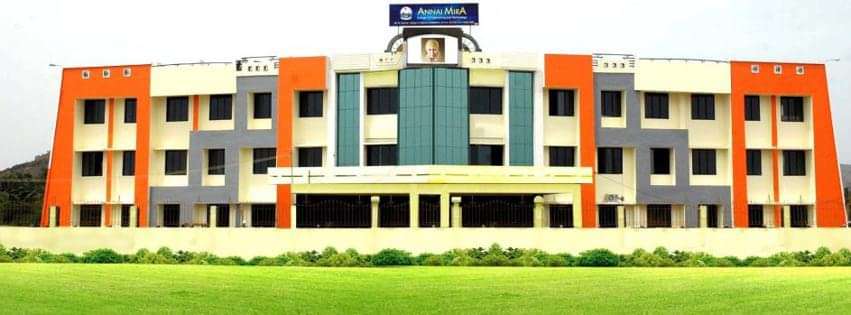
Annai Mira College of Engineering and Technology
About
OfficialAnnai Mira College of Engineering and Technology is a other institution in Vellore, established in 2012. Annai Mira College of Engineering and Technology (AMMCET) is a private engineering college located in Rangampet, approximately 25 km from Vellore city in Tamil Nadu. Established in 2006, the institution emerged from the educational vision of the Annai Mira charitable trust, which has roots in educational philanthropy spanning over two decades. The college is affiliated to Anna University, Chennai, and operates as a self-accredited institution under the academic regulations of the university. With over 2,800 students across undergraduate and postgraduate programs, AMMCET serves as one of the mid-tier engineering colleges in the Vellore district, competing primarily with VIT, SRM, and Lovely Professional institutions in terms of positioning, though with significantly lower fee structures and lower brand recall. The college offers 8 undergraduate engineering disciplines (Mechanical, Civil, Electrical, Electronics & Communication, Computer Science, Mechanical - Robotics & Automation, Information Technology, and Biomedical Engineering) and 5 postgraduate programs (Structural Engineering, Power Systems Engineering, VLSI Design, Computer Science Engineering, and Mechanical Engineering). Academically, AMMCET follows a semester-based curriculum aligned with Anna University, with periodic curriculum updates to incorporate industry trends. The institution emphasizes experiential learning through embedded lab work, industry projects, and mandatory internship programs. Unlike premium-tier engineering colleges in the region, AMMCET does not have autonomous status, which means curriculum flexibility is limited and external university examinations remain standard. The college has established industry partnerships with companies including Infosys, TCS, Wipro, Cognizant, and several manufacturing firms, primarily in placement and guest lecture contexts. Research activities exist but are modest; the college does not have dedicated research parks or centers of excellence comparable to larger institutions. Faculty holds a mix of qualifications—approximately 35% hold PhDs, while others possess industry experience or M.Tech degrees. Teaching quality varies across departments; Computer Science and Electronics & Communication departments show stronger faculty credentials compared to Civil and Mechanical branches. The placement record has improved steadily over the past 3-4 years, with 2023-24 data showing approximately 78% placement rate across all branches, with technology roles dominating. Core engineering placements (manufacturing, infrastructure) are significantly lower than technology placements, which is a structural challenge for non-CS/IT engineering students. Average CTC ranges from 4.5-6.5 LPA for non-CS branches and 6-8 LPA for CS/IT branches, with highest offers reaching 12 LPA (primarily in specialized IT roles). The campus is located in a semi-rural setting approximately 25 km south of Vellore city, which creates isolation challenges for students seeking off-campus entertainment and internship opportunities. The surrounding area is underdeveloped, with limited food options, retail outlets, or recreational facilities within walking distance. This necessitates reliance on college buses or arranged transport for city access, which is a practical drawback compared to urban or well-established suburban campuses. The college actively maintains hostels for both boys and girls, housing approximately 60% of the student population. Hostel facilities are basic but functional, with 2-4 seater rooms, attached bathrooms, and internet connectivity. Mess food is vegetarian-heavy with non-vegetarian options on specific days, quality and variety are average by engineering college standards. The college has established several student clubs and societies covering technical (coding, robotics, cybersecurity), cultural (dance, drama, music), and sports categories. Annual cultural fest "Miravision" and technical fest "Innovision" occur in February and October respectively, with moderate participation and execution. Sports facilities include a basketball court, badminton courts, cricket ground, and gymnasium, though amenities are not state-of-the-art. The college has a dedicated placement cell that interfaces with recruiting companies; placement drives are conducted from August onwards, with final placements by May-June each year. Notable alumni include software engineers at major IT firms, civil engineers in infrastructure projects, and entrepreneurs in tech startups, though the college does not have prominent public figures or industry leaders as alumni. The institution attracts students primarily through the TNEA (Tamil Nadu Engineering Admission) process for state board students and through management quota admissions. Merit-based scholarships are limited; financial aid options are primarily through educational loans and internal fee concessions based on academic performance (top 5% of batch). Students from middle and lower-middle-class backgrounds form the majority of the student body, particularly through TNEA allocations. The college is best suited for students seeking a structured engineering education at affordable costs, those not scoring high enough for tier-1 private universities (VIT, SRM, Lovely) or NIT/IIT, and students comfortable with suburban campus life. It is NOT recommended for students prioritizing premium infrastructure, world-class research facilities, international collaborations, or urban campus experience. Success at AMMCET depends heavily on individual student initiative; the college provides foundation and infrastructure, but students must actively pursue internships, skills development, and networking. The culture is moderately competitive, with emphasis on curriculum completion rather than innovation or entrepreneurship. Ragging is officially prohibited with enforcement mechanisms in place; incidents are rare but occasionally reported. Safety for women students is generally adequate, with separate hostel blocks, campus security, and awareness programs, though the isolated location requires caution during late-night movements.