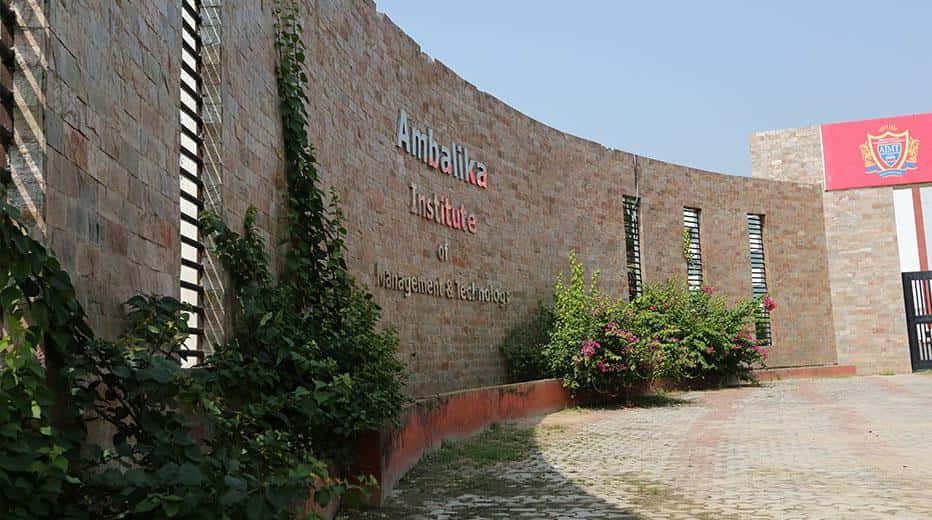
Ambalika Institute of Management and Technology
About
OfficialAmbalika Institute of Management and Technology is a other institution in Lucknow, established in 2008. Ambalika Institute of Management and Technology (AIMT) was established in 2005 in Lucknow, Uttar Pradesh, as a private engineering and management institution. Located in the AMIDC (Ambalika Industrial Development Complex) area on the outskirts of Lucknow, the college has grown to become a moderately recognized institution in North India, particularly in Uttar Pradesh and surrounding regions. The institute is affiliated with Dr. A.P.J. Abdul Kalam Technical University (AKTU), Lucknow, and is approved by AICTE (All India Council for Technical Education). Over nearly two decades, AIMT has developed a modest reputation for technical education, though it operates in a highly competitive market where it faces significant challenges from established NITs, IITs, and other reputed private institutions. The institution offers undergraduate and postgraduate programs primarily in Engineering and Management disciplines, catering to students who do not qualify for premier institutions but seek structured technical education within Uttar Pradesh. AIMT's academic framework emphasizes a blend of theoretical knowledge and practical application, with a focus on skill development and industry-readiness. The engineering programs span Civil, Mechanical, Electronics and Communication, Computer Science, and Electrical Engineering at the undergraduate level, while the postgraduate offerings include MBA with specializations in Finance, Marketing, and HR. The management programs attract both engineers seeking specialized business education and commerce graduates exploring professional management careers. Research at AIMT remains modest and primarily focused on applied domains relevant to regional industries. The college has established partnerships with select manufacturing units, IT firms, and service sector organizations in Lucknow and surrounding NCR-adjacent regions, though these connections are considerably weaker than those of Tier-1 institutions. Faculty research output, measured in publications and patents, is below national averages for technical institutions, reflecting the constraints of a private college in a tier-3 city without substantial research funding. Campus infrastructure has been gradually upgraded since inception. The 18-acre suburban campus houses multiple academic blocks with classrooms equipped with smart boards and projectors, a central library with approximately 45,000 books and digital resources, computer labs with modern hardware, and dedicated spaces for laboratory work in engineering disciplines. The library, while adequate, lacks the extensive journal subscriptions and rare collections found in premier institutions. Laboratories are functional but often operate with equipment that is 5-8 years old, presenting challenges for exposure to cutting-edge technology. The institute maintains separate hostel facilities for boys and girls, though quality and amenities are basic compared to metro-based colleges. The boys' hostel accommodates approximately 600 students across 3 blocks, while the girls' hostel houses around 250 students. Hostel rooms are typically 2-3 sharing arrangements with basic furnishings, and the facilities are maintained to a functional standard. Mess food is reportedly monotonous and quality fluctuates seasonally. Many students prefer renting PGs in nearby localities like Indira Nagar, Gomti Nagar, and Vikas Nagar, which offer more autonomy and variety at comparable or lower costs. Campus connectivity through WiFi is limited to designated areas and often unreliable, a significant drawback for engineering students requiring consistent internet access for coursework and projects. Sports facilities include a modest cricket ground, volleyball courts, badminton courts, and a small gymnasium. A swimming pool and full-scale sports complex are absent, limiting opportunities for swimmers and athletes in niche sports. The institution organizes annual technical fests and cultural programs, though these events have smaller footprints and lower participation compared to more established colleges. Placement and recruitment is the key performance metric for AIMT. The college has built relationships with IT companies, manufacturing firms, and service sector employers over the past 15 years. However, placement statistics reveal significant variability across branches, with Computer Science consistently showing higher placement rates (85-90%) and average salaries in the 5-6.5 LPA range, while Civil and Mechanical engineering branches experience lower placements (60-70%) and median salaries of 3.5-4.5 LPA. Campus recruitment drives typically begin in July-August of the final year, with most offers extended by December. Top recruiters include Infosys, TCS, Cognizant, HCL, Capgemini, and various smaller IT consulting firms. Core engineering placements remain a persistent challenge, with very few manufacturing or infrastructure companies visiting campus regularly. This reflects both the location disadvantage (Lucknow's limited industrial base compared to Pune, Bangalore, or Hyderabad) and the institution's modest brand recall outside Uttar Pradesh. MBA placements are stronger proportionally, with consulting, finance, and FMCG companies recruiting, yielding average salaries of 7-9 LPA for better-performing graduates. Student life at AIMT is characterized by a mix of academic rigor and moderate extracurricular engagement. The student body is predominantly from Uttar Pradesh and neighboring states, with a small minority from other regions. Social and economic diversity is moderate—a significant portion of students come from middle-class backgrounds and are first-generation college attendees, creating a fairly balanced and motivated learning environment. The college promotes a merit-based culture with regular seminars, guest lectures from industry professionals, and skill-building workshops. Technical clubs like the Robotics Club, Programming Club, and Engineering societies are active, though with limited resources and visibility beyond campus. Cultural programs, sports days, and inter-college competitions are organized annually, offering platforms for student engagement outside classrooms. Discipline and conduct are strictly monitored; ragging is officially banned and incidents are rare, contributing to a relatively secure campus environment. However, the quality of student experience varies considerably depending on branch and hostel location. Computing students report higher satisfaction due to better job outcomes and course relevance, while Civil and Mechanical students often express frustration over limited recruitment and perceived curriculum rigidity. The college has gradually improved its reputation over the past 5-7 years through consistent placements, alumni network building, and infrastructure upgrades, yet it remains a local-tier institution without the pan-India recognition or research prominence of top-tier colleges. Prospective students should approach AIMT as a pragmatic choice for subsidized technical education in North India, particularly if entrance into NITs or other central universities is unattainable. The institution suits students who are geographically rooted in Uttar Pradesh, prefer a less intensely competitive environment than JEE-advanced cutoff colleges, and are willing to invest effort in securing IT/services sector placements. It is less suitable for students aspiring to core engineering careers, research-oriented paths, or those seeking a metropolitan college experience with high-visibility brand value. The fee structure, while moderate for private institutions (approximately 4.5-5.5 lakhs per annum for engineering programs), demands careful cost-benefit analysis against alternative options. Students should seriously consider whether the AIMT degree will yield sufficient ROI in their target job market. For those from economically weaker backgrounds, the college does offer scholarship schemes, though these are limited and competitive. The overall institutional trajectory is one of consolidation and incremental improvement rather than transformative growth, making it a safe but not exceptional choice in India's fragmented higher education landscape.