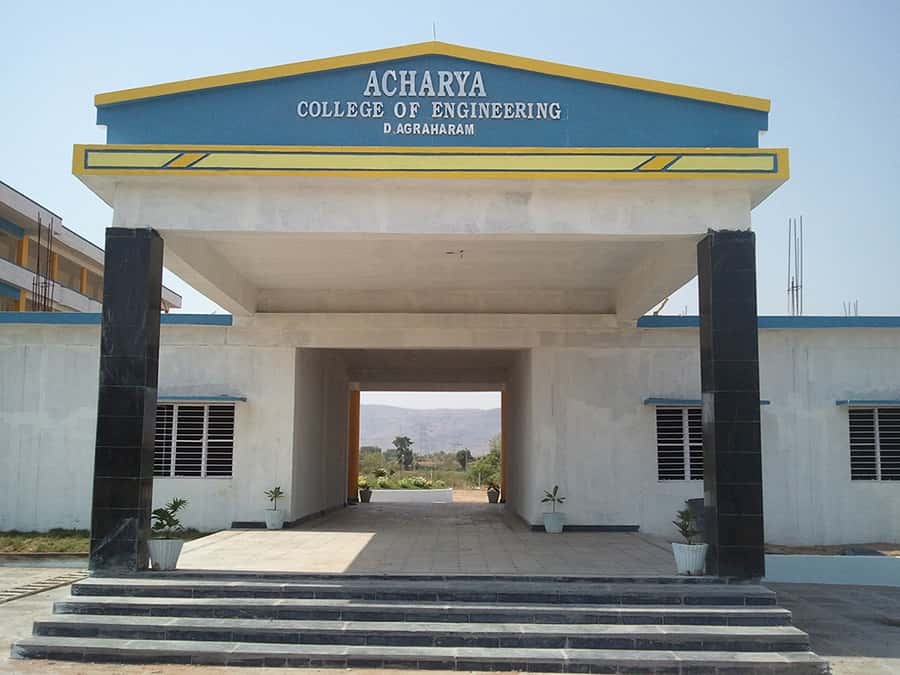
Acharya College of Engineering
About
OfficialAcharya College of Engineering is a other institution in Kadapa. Acharya College of Engineering (ACE) is located in Kadapa, Andhra Pradesh, and was established in 2007 as a private engineering institution. The college is situated on a suburban campus approximately 15 kilometers from the city center, making it relatively isolated but peaceful for focused academics. The institution operates under the Acharya Educational Trust and has grown to become one of the mid-tier engineering colleges in Andhra Pradesh, serving approximately 2,800 undergraduate and postgraduate students across various engineering disciplines. The college is affiliated with Jawaharlal Nehru Technological University (JNTU), Anantapur, which sets its curriculum standards and examination patterns. ACE offers a diverse portfolio of undergraduate and postgraduate programs spanning civil, mechanical, electrical, electronics and communication, computer science, information technology, and newer branches like artificial intelligence and machine learning. The college maintains modest infrastructure with computer labs, engineering workshops, a central library with around 15,000 volumes, and sports facilities spread across the suburban campus. Academically, the institution follows a traditional engineering curriculum with a focus on core fundamentals, though hands-on project-based learning has been gradually integrated into the curriculum. The college conducts placements through a dedicated placement cell, with placement outcomes varying significantly by branch, with IT and CSE branches typically achieving higher placement rates (75-85%) compared to core engineering branches (55-70%). The institution has produced graduates working in IT companies, manufacturing firms, and research organizations, though it has not achieved prominence in terms of producing nationally recognized entrepreneurs or research leaders. The faculty base consists primarily of M.Tech and M.S. degree holders, with very limited PhD representation (approximately 12-15% of faculty), which limits advanced research capabilities. The college's research contributions are minimal, with no significant research centers or published research output. Campus life is relatively subdued, with basic student clubs and annual cultural/technical fests, though participation rates are modest. The housing infrastructure includes separate hostel facilities for male and female students with occupancy ranging from 800-1000 students. The college maintains a curfew-based hostel system and vegetarian-focused mess facilities. Safety and discipline are emphasized through strict conduct codes and regular monitoring. The institution is recognized by AICTE (All India Council for Technical Education) but does not hold NBA (National Board of Accreditation) accreditation for any engineering branches, which limits its credibility for campus recruitment and higher education mobility. ACE should be considered a backup option for students who are unable to secure admission to top-tier colleges (NIT, IIIT, or tier-1 private institutions) but still wish to pursue engineering. The college is most suitable for students from middle-income families in Andhra Pradesh and neighboring states who prioritize affordable education and are willing to invest in self-learning and competitive exam preparation alongside college coursework. The isolated suburban location offers a distraction-free environment but limits exposure to urban cultural experiences and industry networking opportunities. Realistic expectations should be set regarding placement outcomes, particularly for core engineering branches where market demand is lower. The college is particularly not recommended for students from metropolitan backgrounds accustomed to urban amenities, as Kadapa offers limited entertainment, dining, and shopping options. Success at ACE largely depends on individual initiative, peer group quality, and self-directed learning, as the institution provides foundational academics but limited handholding or mentorship beyond classroom teaching.